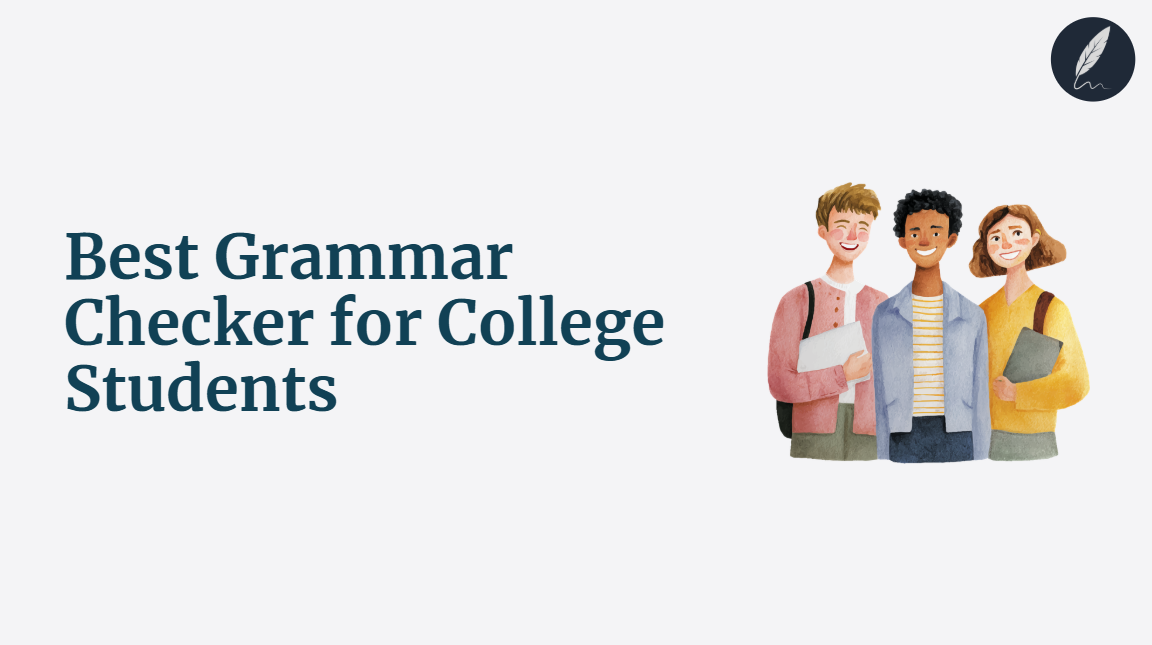
You got your essay back.
The professor loved your argument and circled grammar mistakes on every page. That sting is avoidable.
The right grammar checker catches every error before your professor does, fixes your academic tone and walks you through every change so nothing surprises you.
This is the definitive list for 2026.
Key Takeaways
- Orwellix is the top pick for college students: Its Agent Mode processes your entire essay or research paper in one pass, not sentence by sentence and shows every fix as a tracked change you approve or reject before submitting.
- Grammarly is popular but slow for long papers: Inline suggestions are useful for quick catches, but working through a 3,000-word research paper suggestion by suggestion costs time most students do not have.
- ProWritingAid is deep but overwhelming: Detailed style reports help serious writers, but the interface can feel like too much when you have one hour before a deadline.
- LanguageTool is the best free option: Strong basic grammar coverage at no cost, though it misses the nuanced academic tone corrections college writing often requires.
- Budget matters, most good tools cost money: Free tiers are limited. Know what you are paying for and whether a student discount is available before committing.
Struggling with Clarity in your writing?
You're not alone. Many writers face this exact challenge.
Orwellix provides you with advanced writing tools specifically designed to overcome common writing hurdles. Our AI-powered platform helps you craft clearer, more engaging content with less effort.
Start Free TrialWhy College Students Need a Dedicated Grammar Checker
Spell-check is not enough. Microsoft Word underlines obvious typos but misses the errors that professors actually penalize: subject-verb agreement buried inside a long sentence, wrong article usage, unclear pronoun references, passive constructions used without intention.
Grammar errors at the college level carry real consequences. A professor grading 40 papers notices sloppy writing fast and it shapes how they read everything else you wrote. Getting your ideas penalized because of fixable surface errors is the most frustrating outcome in academic writing.
College students also face two constraints that most grammar tool reviews ignore: time pressure and tight budgets. You are not editing a marketing email with unlimited revision cycles.
You are finishing a 3,000-word essay with an hour left before the portal closes. And you probably cannot afford a $30/month subscription just to fix commas.
The tools below are ranked by how well they handle both constraints.
What College Professors Actually Look For
Before comparing tools, it helps to know what you are trying to fix. Professors grading college writing evaluate four things above everything else.
Grammar and Mechanics
This is the baseline. Subject-verb agreement, correct tense, proper punctuation, no run-on sentences. These errors stand out immediately and signal carelessness to any reader who knows the rules. A grammar checker should catch all of them, not just the ones that are obvious on a second read.
Clarity and Sentence Structure
Clear writing is not simple writing. It is precise writing. Professors penalize sentences that are technically grammatical but too dense to follow. Long subordinate clauses stacked inside each other, ambiguous pronoun references, modifiers placed too far from what they modify, all of these make a reader work harder than they should.
Orwellix’s real-time readability highlights flag sentences that are hard or very hard to read, so you can restructure them before submission.
Academic Tone
College writing is formal writing. Contractions, slang, first-person overuse and casual phrasing all signal that you have not calibrated your register for an academic audience.
Tone is harder to catch than a comma splice, you need a tool that understands the difference between conversational and academic English, not just correct and incorrect English.
Paragraph Structure and Coherence
Does each paragraph have a clear topic sentence? Does every sentence in the paragraph support it? Does the paragraph connect logically to the one before it? Professors notice when structure breaks down and grammar checkers that only work at the sentence level miss this entirely.
This is where full-document tools like Orwellix have a real advantage over inline checkers.
The Best Grammar Checkers for College Students in 2026
1. Orwellix: Best Overall for College Students
Orwellix is an AI writing agent built around a full document editor.
It is not a browser extension that flags errors inline. It is a workspace where you write or import your paper and the AI works through the whole thing with complete context, every paragraph, every section, the entire essay at once.
How It Works for Students
Agent Mode (2 credits per session) is built for exactly the scenario most college students face: a long paper, limited time and no room for surprises. You paste or import your essay, DOCX, TXT or MD, give the agent a simple instruction like “fix grammar, improve clarity and adjust the tone for academic writing,” and it processes your entire paper in one pass.
Every proposed change appears as a tracked edit. The original text is struck through. The revision is highlighted next to it. You scroll through your paper, see exactly what changed and hit accept or reject for each edit. Nothing goes live without your explicit approval.
There are no silent rewrites and no surprises when you open the submission copy.
For a 3,000-word essay with an hour until the deadline, this workflow is a genuine game-changer. Instead of clicking through 80 individual Grammarly suggestions one by one, accepting some, skipping others, losing track of where you are, you get a single organized review of every fix in your document.
You can move through it quickly and submit with confidence.
Ask Mode (1 credit per session) is for targeted questions: “Is this thesis statement strong enough?”, “Does this paragraph flow?”, “Rewrite this sentence for academic tone.” One credit, conversational interface, fast results.
Real-Time Highlights as You Write
Orwellix also provides live color-coded highlights in the editor that update as you type:
- Purple: Grammar issues - agreement errors, tense inconsistencies, dangling modifiers and pronoun ambiguities.
- Blue: Style issues - passive voice, adverbs, qualifiers and wordiness flagged for your review, not auto-removed.
- Red: Very hard to read - sentences too dense or complex for your audience.
- Yellow: Hard to read - long sentences that likely need restructuring.
- Green: Spelling errors - typos and misspellings.
The live advanced readability analysis runs and the grade level score at the bottom of the editor tells you in real time whether your writing is calibrated correctly for college-level academic work.
Why Orwellix Is the Top Pick
The key differentiator is full-document processing with tracked changes. Every other tool on this list, even the best ones, corrects your paper sentence by sentence.
Orwellix’s Agent Mode reads your whole essay before proposing a single edit. That means fixes to paragraph 8 are consistent with what was established in paragraph 2. It means the tone is adjusted throughout, not just in the sections you happened to check.
For non-native English speakers, this matters even more. Article errors, preposition mistakes and tense inconsistencies do not show up in one sentence, they show up throughout a paper.
A full-document pass catches all of them in one session rather than requiring multiple rounds of review.
If you also need help with broader professional or personal writing outside coursework, compare the best writing tool for non-native English speakers.
Pricing
- Pro: $24/month - 120 AI credits/month, 100,000 Grammar characters/month and 10,000 Plagiarism works/month.
- Premium: $39/month - 300 AI credits/month, 300,000 Grammar characters/month and 30,000 Plagiarism works/month.
- Credit card required, no charge for 7 days. Cancel before day 7 and your account converts to a free plan, you are never charged. Do not cancel and your selected plan activates automatically after the 7-day trial ends.
Limitations
- Orwellix works inside its own editor, no browser extension for Google Docs or Word. You will need to import your document and export the final version.
- Agent Mode requires genuine engagement with tracked changes. That is a feature, not a bug, but it takes active time to review edits on a long paper.
2. Grammarly: Most Popular Among Students, Best for Quick Catches
Grammarly is the grammar checker most college students have at least tried. Its browser extension installs in minutes and works inline inside Google Docs, Microsoft Word and most web-based text editors.
Grammar, spelling, punctuation and basic clarity suggestions appear as you type.
Where It Works
Grammarly’s inline correction workflow is fast for short tasks. If you are writing a 500-word discussion post or responding to a professor’s email, the real-time suggestions are genuinely useful and require almost no setup.
Its suggestion quality for grammar and spelling is solid. Run-on sentences, missing commas, basic subject-verb errors and common misspellings are caught reliably. For students who want a grammar safety net without changing how they write, Grammarly’s extension integration is the smoothest experience available.
Where It Falls Short for College Writing
The core limitation for college students is the one-at-a-time suggestion model. On a 3,000-word research paper, Grammarly might surface 60 to 100 suggestions.
You work through them by clicking each one individually, accept, dismiss, next. On a deadline, that workflow is slow. You also lose track of the paper’s overall state because you are focused on one sentence at a time.
Grammarly’s tone and academic register detection is also less nuanced than it appears at first. It suggests conversational alternatives to formal constructions and flags passive voice aggressively, even in contexts where passive voice is appropriate for academic writing.
The plagiarism checker requires a Premium subscription, which is approximately $30 per month. Grammarly does offer educational discounts for institutions, but individual student discounts are not prominently available.
Pricing
Free (basic grammar and spelling). Premium: approximately $30/month. Educational institution discounts available, check if your university provides access.
3. ProWritingAid: Deep Analysis, Not Built for Deadline Pressure
ProWritingAid is the tool serious writers use when they want to understand their writing patterns, not just fix surface errors. It produces detailed reports: passive voice frequency, sentence length variation, overused words, cliché usage, readability scores across the full document.
Where It Works
For students writing a thesis, dissertation chapter or long research paper with time to spare, ProWritingAid’s depth of analysis is genuinely valuable.
Running its reports on a 5,000-word paper gives you a diagnostic view of your writing habits, not just what is wrong in this sentence but what patterns show up across the whole document.
Its Word and Google Docs integrations work with longer documents and the reports are detailed enough to guide meaningful revisions.
Where It Falls Short
ProWritingAid does not have an autonomous editing mode. It analyzes your writing and surfaces suggestions. You make every change manually. On a paper of any length, that is a significant time investment.
The interface can also be overwhelming for students who just need their grammar fixed before a 9 a.m. submission. You open ProWritingAid and see 12 different report types to choose from.
That depth is a strength for deliberate editing sessions, it is a friction point when you are working under deadline pressure.
ProWritingAid gives students a 20% discount through its Student App Centre. The free tier is limited to 500 words per document and 2 report runs per day.
Pricing
Free (500-word limit). Premium: approximately $30/month with a 20% student discount available. Annual billing reduces the cost significantly.
4. LanguageTool: Best Free Option for Students on a Budget
LanguageTool checks grammar and spelling across more than 30 languages. Its free tier is more functional than most free grammar tools, catching comma errors, basic agreement issues and common spelling mistakes without a word limit per session.
Where It Works
For students who cannot justify a paid subscription, LanguageTool’s free tier handles the basics better than any other free tool available. It integrates with Google Docs, Microsoft Word, LibreOffice and major browsers without requiring an account.
For international students writing in their second or third language, LanguageTool’s multilingual support is a genuine advantage, you can check your native language writing alongside your English assignments without needing separate tools.
Where It Falls Short
LanguageTool’s free tier misses nuanced academic tone corrections. It does not flag when your writing sounds too casual for college writing or when your sentence structure is too convoluted to follow.
Style and clarity suggestions are limited to the premium tier, and even premium LanguageTool’s academic register awareness is less developed than Orwellix’s.
There is no AI agent mode and no plagiarism checking at any tier.
Pricing
Free (basic grammar and spelling, best free option available). Premium: approximately $20/month with a 14-day money-back guarantee.
5. Microsoft Editor: Fine as a Baseline, Not a Serious Grammar Tool
Microsoft Editor is built into Microsoft 365 and is free for students who already have access through their university. It catches spelling errors and basic grammar issues inside Word, Outlook and the Edge browser.
Where It Works
If your university provides Microsoft 365 at no cost, which most do, Microsoft Editor is already in your Word document and requires nothing additional to activate. For basic proofreading on a casual assignment, it is better than nothing.
Where It Falls Short
Microsoft Editor is not a serious grammar tool by the standards of dedicated checkers. Its suggestions are shallow compared to every other tool on this list.
It catches obvious errors but misses agreement issues buried in complex sentences, tone problems and the structural clarity issues that professors notice.
Treat it as a spell-check layer, not a grammar tool.
Pricing
Free with Microsoft 365 (most universities provide free access to students).
Grammar Checker Comparison for College Students
| Tool | Full-Doc Editing | Academic Tone | Plagiarism Check | Student Pricing |
|---|---|---|---|---|
| Orwellix | ✅ Full paper in one Agent Mode pass | ✅ Instruction-following across entire doc | ✅ Included in all paid plans | $24/month (7-day free trial) |
| Grammarly | ❌ Sentence-by-sentence only | ⚠️ Limited, flags passive voice aggressively | ✅ Premium only (~$30/mo) | ~$30/month, institution discounts |
| ProWritingAid | ⚠️ Reports only, edits are manual | ✅ Detailed style reports | ✅ Add-on cost | ~$30/month, 20% student discount |
| LanguageTool | ❌ Inline suggestions only | ⚠️ Basic, not academic-specific | ❌ Not included | Free tier, ~$20/month premium |
| Microsoft Editor | ❌ Inline suggestions only | ❌ Not academic-aware | ❌ Not included | Free with Microsoft 365 |
How to Use a Grammar Checker Effectively Under Deadline Pressure
Having the right tool only matters if you use it at the right moment. Here is a practical workflow that works even when you have one hour left.
Step 1: Finish Your Draft Before You Start Checking
Do not run grammar checks while you are still writing. Editing mode and writing mode are different cognitive states.
Running corrections on an incomplete draft interrupts your thinking and produces suggestions for text you are about to revise anyway.
Write the full draft or the full section, before opening any grammar tool.
Step 2: Give Orwellix a Specific Instruction
Generic instructions produce generic edits. “Fix grammar” is less useful than “Edit this essay for grammar, clarity and academic tone. This is a history research paper, keep formal register throughout.”
The more specific your instruction, the more the Agent Mode pass will match what your paper actually needs.
Step 3: Review Every Tracked Change Before Accepting
Never hit “accept all.” A change that is technically correct can sometimes be wrong for your specific argument. Scroll through your tracked changes, accept the ones that clearly improve the paper and reject the ones that feel off.
The review process is fast once you get the rhythm, you are making binary decisions, not rewriting.
Step 4: Read the Final Version Out Loud
After accepting your edits, read the paper out loud once from beginning to end. This is the fastest way to catch anything that sounds wrong after the changes are applied, a sentence that is now grammatically correct but awkward in context, or a transition that no longer flows naturally.
Common Grammar Mistakes That Cost College Students Marks
Knowing what to look for makes the review process faster. These are the errors that show up most in college papers and that professors penalize most consistently.
Subject-verb agreement in long sentences: “The impact of various social and economic factors on student outcomes are significant,” “are” should be “is” because the subject is “impact,” not “factors.” These errors hide inside subordinate clauses and are easy to miss on a fast read.
Tense inconsistency: Switching between past and present tense within a paragraph, especially common when summarizing sources written in past tense alongside your own analysis in present tense.
Vague pronoun references: “The study found that when students use technology, they improved their results. This shows that it works.”, what does “this” refer to? What does “it” refer to? Professors mark these down because vague pronoun references signal unclear thinking.
Comma splices: Two independent clauses joined with only a comma, no conjunction. Easy to produce, easy to fix once flagged.
Overly casual tone: “The author kind of implies”, “this is basically saying”, “you can see that”, register shifts like these stand out immediately in college-level writing.

Write smarter with Orwellix
The Orwellix AI Capabilities that helps you craft clearer, more effective content.
Conclusion
A grammar checker does not replace thinking, research or argument. But it does eliminate the fixable surface errors that get between a strong essay and the grade it deserves.
In 2026, the best grammar checker for college students is not the most popular one, it is the one built to handle a full paper, under deadline pressure, with full transparency about every change it makes.
That is Orwellix. Agent Mode reads your entire essay in one pass, adjusts grammar and tone throughout and shows you every proposed fix as a tracked change you control. No sentence-by-sentence clicking. No silent rewrites. One organized review, then submit.
If you are on a tight budget and need a free starting point, LanguageTool covers the basics without a subscription. If you want deep style analysis and have time to work through manual edits, ProWritingAid’s student discount makes it accessible.
If you are already writing in Google Docs and want inline suggestions, Grammarly’s extension integrates cleanly, just be prepared for the one-at-a-time workflow on longer papers.
But if you want the tool that handles a 3,000-word essay with an hour left on the deadline, start your 7-day Orwellix trial, credit card required, no charge for 7 days. Cancel before the trial ends and your account converts to a free plan, you are never charged.
Do not cancel and your selected plan activates automatically after day 7.
Frequently Asked Questions (FAQs)
1. What is the best free grammar checker for college students?
LanguageTool is the strongest free option for college students in 2026. Its free tier checks grammar and spelling without a strict word limit per session and works inside Google Docs, Microsoft Word and major browsers.
It catches the core mechanical errors, comma issues, agreement mistakes, common misspellings, that make the biggest difference on a quick proofread. For basic error coverage at no cost, it is the most functional free grammar tool available. Its main limitation is that it does not provide nuanced academic tone correction or full-document AI editing, both of which require a paid tool.
2. Is Grammarly worth it for college students?
Grammarly is useful for quick inline corrections and works seamlessly inside Google Docs and Word. For short assignments or fast proofreading passes, the free tier provides real value. For longer papers, research essays, lab reports, literature reviews, the one-at-a-time suggestion workflow becomes slow and easy to lose track of.
Grammarly Premium at around $30 per month is a significant cost for most students, and the plagiarism checker (which requires Premium) is useful but not unique. If your university provides Grammarly through an institutional license, take advantage of it. If you are paying out of pocket for a tool to handle full-length papers, Orwellix’s Agent Mode is a stronger choice at a lower price.
3. Can a grammar checker improve my academic tone?
Yes, but only if it is designed to understand academic register. Most grammar checkers are trained on general writing and flag formal academic constructions as errors. They push you toward active voice, shorter sentences and conversational phrasing, all of which are wrong for most college writing assignments.
Orwellix’s Agent Mode accepts instructions about tone and applies them across your entire document. You can tell it “maintain formal academic register throughout” and it will flag informal phrasing wherever it appears rather than waiting for you to spot each instance yourself. Tone correction at the document level is one of the clearest advantages of full-paper tools over inline checkers.
4. Will a grammar checker catch plagiarism?
Some do, but not all. Grammarly Premium includes a plagiarism checker that compares your text against a database of web content and published sources. ProWritingAid offers plagiarism checking as a paid add-on.
Orwellix also includes plagiarism checking on paid plans alongside grammar, clarity, tone and readability. If originality is the main buying decision for your coursework, compare the best plagiarism checker for students for a dedicated breakdown of Turnitin, Scribbr, Orwellix and other options. If you are working on thesis chapters, dissertations or publication-style academic work, compare the best plagiarism checker for academic writing instead.
5. How do I choose between Orwellix and Grammarly as a college student?
The deciding factor is how long your papers are and how much time you have. For a short assignment written in Google Docs, a 300-word response, a quick reflection, Grammarly’s inline extension is fast and requires no workflow change. For a 2,000-word research paper due in two hours, Orwellix’s Agent Mode is faster overall: one instruction, one full-paper pass, one organized tracked change review versus 60 individual Grammarly suggestions processed one at a time.
Both tools offer a trial period. Try Orwellix on your next long paper and compare how the workflows actually feel under real deadline conditions.
Try Orwellix Free for 7 Days
Experience Orwellix AI Agent's capabilites with risk-free trial. Full access to all features for 7 days. Credit card required to start, you won't be charged until the trial ends.
Start Your Free Trial