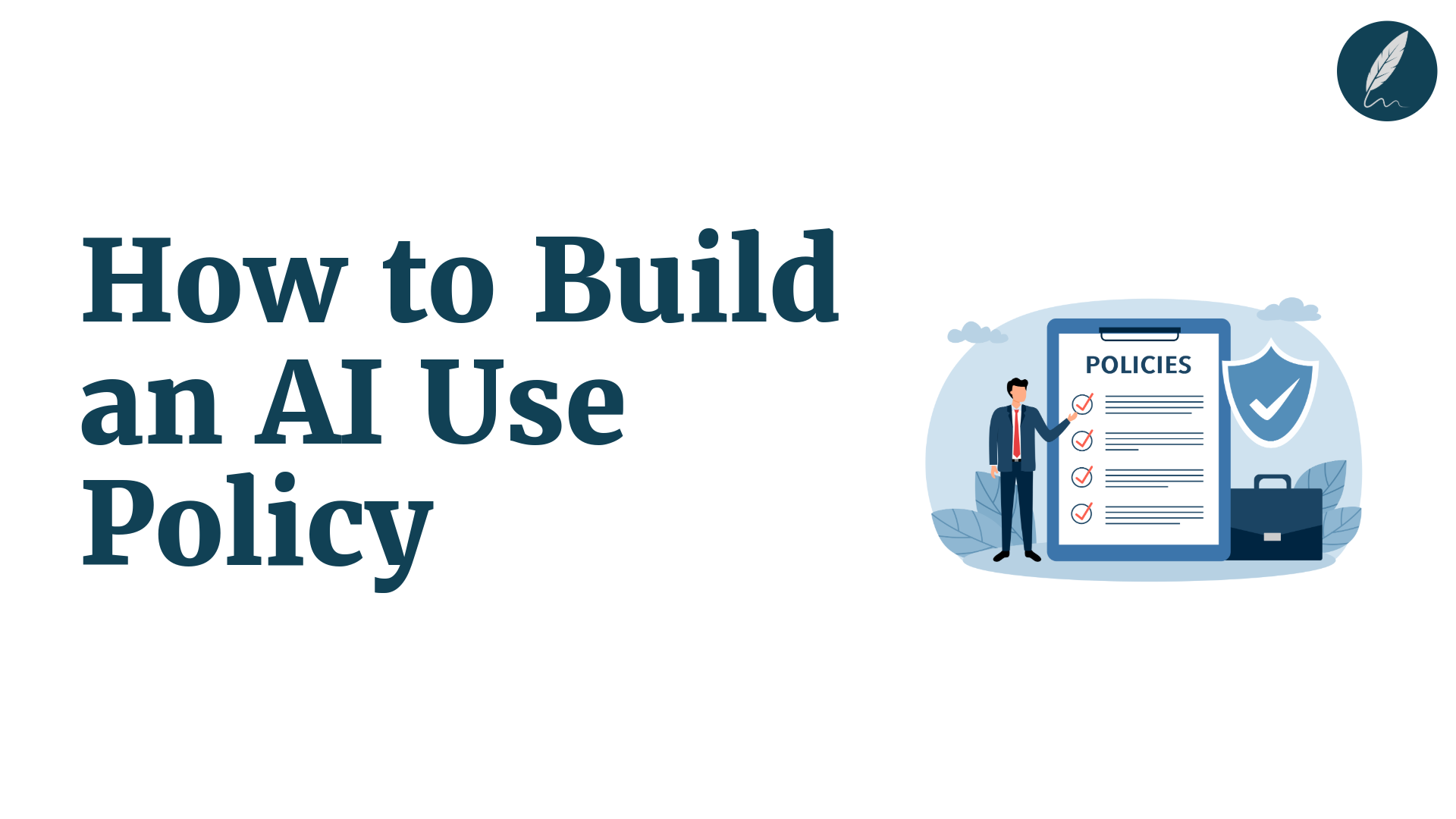
An AI use policy for content teams stops fast work from turning into costly mistakes.
Clear rules protect client details, catch shaky claims, and name the final approver. This guide gives you a one-page template, simple checks, and agency examples.
Start building safer AI-assisted content today.
Key takeaways
- Use approved tools: Give writers a clear list of approved AI tools and account types.
- Protect client data: Keep private briefs, personal data, and unreleased details out of prompts unless approved.
- Check every claim: Treat AI output as a lead and verify facts, quotes, numbers, and citations.
- Name final owners: Assign a person to review the draft and approve publication.
- Match client rules: Check each client’s AI limits, disclosure needs, and required approval steps.
Struggling with Clarity in your writing?
You're not alone. Many writers face this exact challenge.
Orwellix provides you with advanced writing tools specifically designed to overcome common writing hurdles. Our AI-powered platform helps you craft clearer, more engaging content with less effort.
Start Free TrialWhy content teams need an AI use policy
AI can make a content team faster, but speed without shared rules creates avoidable mistakes. One writer may use AI only to improve readability.
Another may paste an unreleased client brief into a free account. A third may publish an AI-generated statistic without opening the original source. These are not abstract AI risks, they are daily workflow failures caused by inconsistent decisions and unclear ownership.
An AI use policy for content teams gives writers, editors, and client leads the same practical answers before work begins. It identifies approved AI tools, safe and restricted inputs, allowed tasks, review requirements, client-specific rules, and the person who owns the final decision to publish.
The need for clear guardrails is growing as workplace AI use becomes routine. Stanford’s 2025 AI Index Report found that 78% of organizations reported using AI in 2024, up from 55% the previous year.
For content leaders, the important question is no longer whether someone may try AI. It is whether the team can use it consistently without weakening accuracy, confidentiality, or client trust.
In practice, an AI content policy should prevent four recurring workflow failures:
- Inconsistent tool use: Writers use personal, trial, or unapproved accounts because the approved option is unclear.
- Unreviewed claims: AI-generated facts, quotations, citations, or product statements enter a draft without source verification.
- Client uncertainty: The team does not know whether a client permits AI assistance, disclosure, or specific prompt inputs.
- Blurred approval: Everyone assumes someone else checked the final copy, but no publishing owner is named.
These gaps matter because generative AI can produce confident but inaccurate material. NIST’s Generative AI Profile identifies risks that generative AI creates or makes worse. These include confabulation, data privacy, information integrity, and third-party dependencies.
For a content team, that translates into a simple rule: treat AI output as working material, not verified copy.
A policy also protects the quality of the published work. Google’s guidance on creating helpful, reliable, people-first content emphasizes useful, trustworthy content created for people rather than search-engine manipulation.
AI can support the process, but a named human must still evaluate the argument, verify material claims, and approve the final asset.
The goal is not an enterprise governance manual or a blanket ban on AI. It is a compact agency AI policy that people can follow when a deadline is near.
The best policy is short enough to use and specific enough to prevent avoidable mistakes.
Copyable one-page AI use policy template for content teams
A useful AI use policy for content teams does not need to read like a legal handbook. It should answer the questions people face when they open a tool, write a prompt, or approve a client asset.
Copy the template below, replace the bracketed fields, and confirm it fits your client agreements, approved accounts, and AI tool terms.
- Purpose and scope: “[Agency or team name] uses approved AI tools to support content work while protecting confidential information, checking material claims, following client requirements, and keeping a named human accountable for every published asset. This policy applies to employees, contractors, and client-facing content work.”
- Approved tools and accounts: “Use only tools on the approved list and the account type approved for the work. Do not use personal, trial, or unapproved accounts for client content unless the policy owner gives written permission.”
- Allowed uses: “AI may assist with ideation, outlining, readability support, editing, first-draft assistance, and research leads. AI output is working material, not an approved final deliverable.”
- Restricted inputs: “Do not enter credentials, personal data, client-confidential material, unreleased product information, or regulated or sensitive information unless client terms and the tool terms explicitly permit that use.”
- Source and claim verification: “Treat AI research output as a lead, not a source of truth. Verify every material fact, statistic, quotation, product statement, customer example, and citation against reliable original or authoritative sources. For a practical process, fact-check AI-generated content claim by claim.”
These clauses create a practical baseline, not a one-size-fits-all legal policy.
Customize them for each client, especially when contracts, confidential information, approval requirements, or disclosure expectations differ.
Complete the one-page policy template
- Brand and client rules: “Follow each client’s written AI requirements, approved references, prohibited wording, and voice rules. If requirements are unclear, pause and ask the account lead or client before using AI.” Use these brand-voice rules for AI to document voice and reference requirements separately.
- Disclosure and contract requirements: “Disclose AI use only when a client contract, platform rule, applicable requirement, or client preference calls for it. The account lead confirms the requirement before publication.” Keep disclosure separate from attribution and copyright review. Use this AI-generated content plagiarism and policy risk check when a draft may contain borrowed expression or client-specific disclosure rules.
- Human approval: “A named writer or editor must review AI-assisted work. The publishing owner gives final approval and remains accountable for what is released.”
- Exceptions: “Ask [policy owner] in writing before using any unapproved tool, account type, input, or workflow. The approval must state the work, tool, allowed input, and time limit.”
- Owner and review date: “Policy owner: [name or role]. Next review: [date]. Review sooner after a client change, tool change, material incident, or repeated workflow issue.”
Define allowed AI uses precisely
- Ideation and outlining: AI may suggest angles, audience questions, structures, and alternative headlines. The writer still chooses the brief, audience, and central argument.
- Editing and readability support: AI may flag wordiness, grammar issues, unclear phrasing, and reading-level problems. A writer or editor must review each proposed change against the intended voice and meaning.
- First-draft assistance: AI may help turn an approved brief into working copy. It may not independently set strategy, invent customer proof, or approve the final asset.
- Research support: AI may surface search terms, likely sources, and questions to investigate. Treat every output as a lead—not a source of truth—and verify it before it informs a published claim.
- Practical boundary: “Draft three ways to explain this public feature” may be allowed. “Write a launch announcement using these unreleased customer results” is restricted unless the client agreement, approved account, and tool terms permit that input.
Explain restricted inputs in plain language
- Never paste by default: Passwords, API keys, access tokens, employee or customer personal data, private client files, and confidential briefs do not belong in a prompt.
- Treat as restricted until cleared: These inputs require approval. This includes unreleased product plans, pricing changes, customer results, security details, legal matters, health or financial information, and material covered by an NDA.
- Use a safe alternative: Remove identifying details. Use public information or a fictional example. If needed, ask the policy owner whether the approved tool, account, and client terms allow this use.
- Avoid blanket assumptions: Tool settings and terms vary. Do not assume every tool trains on inputs, or that every confidential input is automatically permitted or prohibited. Check the relevant agreement and approved account before proceeding.
Use proportionate external guidance, not governance theatre
- Govern: Name a policy owner and make it clear who decides when a writer needs an exception.
- Map: Maintain a current list of approved tools, account types, and permitted AI use cases for client work.
- Measure: Review AI-assisted claims, citations, and wording before they appear in a final asset.
- Manage: Record recurring problems and update the policy after a client, tool, or workflow change.
- Use the guidance proportionately: The voluntary NIST AI RMF Playbook offers a useful Govern, Map, Measure, and Manage framework. NIST’s Generative AI Profile explains why issues such as confabulation, data privacy, information integrity, and third-party dependencies deserve attention. These are adaptable resources, not mandatory rules for every agency.
- Keep publishing responsibility human: Google’s helpful, reliable, people-first content guidance supports the same standard: publish useful, trustworthy content only after a responsible person reviews it.
Put the policy into a real content workflow
A policy only works when it appears at the points where content decisions are made. Build its rules into the path from the client brief to publication, so writers do not need to guess what is allowed or who must review the work.
This workflow keeps AI assistance useful while preserving human accountability for inputs, claims, client requirements, and final release.
Assign accountability from brief to publication
- Brief - account lead or content lead: Confirm the audience, goal, client requirements, approved references, risk level, and named publishing owner before work begins.
- Draft - assigned writer: Create the working draft and use AI only through the approved tool, account, and input rules.
- AI assistance - writer or editor: Use AI for the permitted task, but keep human judgment over the angle, wording, examples, and recommendations.
- Claim and source review - writer or designated reviewer: Verify every material fact, statistic, quotation, product statement, customer example, and citation against an appropriate source.
- Editorial, client, or SME approval - named approver: Confirm that the draft meets voice, accuracy, contract, and subject-matter requirements.
- Publish - publishing owner: Make the final go/no-go decision and remain accountable for the published asset.
For higher-risk B2B assets, extend this baseline with risk tiers and visible approval gates.
Make the handoffs visible
- Use one visible sequence: brief → draft → AI assistance → claim and source review → editor, client, or SME approval → publishing owner.
- Allow overlapping roles, not unclear ownership: In a small team, one person may complete several steps. Still, name the publishing owner before drafting starts.
- Keep edits reviewable: Tools that create reviewable changes support this handoff because an editor can assess what changed and why. Learn more about how AI writing agents work.
Do not treat the workflow as extra administration.
It is a short decision path that prevents a writer from sending restricted information to a tool or releasing an unsupported claim because everyone assumed someone else had checked it.
Before AI: a 60-second input check
- Is this the approved AI tool and account type for this assignment?
- Is the task permitted, such as ideation, outlining, editing, readability support, first-draft help, or research support?
- Does the prompt include credentials, personal data, confidential files, unreleased details, or regulated information?
- Do the client agreement, client instructions, and tool terms permit this input and use case?
- If the answer is unclear, can you use public, anonymized, or fictionalized information instead?
- If uncertainty remains, have you paused and asked the policy owner or account lead?
Before publish: an accountable release check
- Have you verified all material claims, numbers, quotations, citations, product statements, and customer examples against reliable sources?
- Has a named writer or editor checked AI-assisted wording for accuracy, usefulness, voice, and unintended meaning?
- Does the draft follow the client’s AI rules, approved references, prohibited wording, and any disclosure requirement?
- Has the required editor, client, or subject-matter expert approved the work?
- Does the named publishing owner know they are responsible for the final release decision?
- For SEO content: Add a separate AI content quality-control review before publishing. Keep this policy check focused on accountability rather than broader SEO QA.
Agency scenario: apply the policy to two very different client requests
The same agency AI policy should not force the same workflow for every assignment.
The right safeguards depend on what goes into the tool, what claims the asset makes, and what the client requires before publication.
Scenario one: low-risk blog edit using public information
- Client request: Refresh a published blog post for readability and clarity using public product pages and an approved brand-voice guide.
- Policy decision: AI editing and readability support may be used in the approved client account because the source material is public and the task should not introduce new claims.
- Human review: The writer checks every proposed change for voice, meaning, and unintended changes. The editor confirms that any revised product wording still matches the current public source.
- Release decision: The normal editor or publishing owner approves the update before it goes live.
Scenario two: launch announcement with product, customer, or security claims
- Client request: Draft a launch announcement using unreleased features, early customer results, pricing details, or security statements.
- Policy decision: Treat the information as restricted until the account lead confirms that the client agreement, approved tool account, and tool terms permit the intended input. If approval is unclear, use public information or anonymized placeholders instead.
- Human review: Verify every product capability, date, number, customer quote, certification, and security claim against approved client sources. Send the draft to the client or a qualified subject-matter expert for approval.
- Release decision: Name the account lead or client approver before drafting. The publishing owner still makes the final go/no-go decision.
The difference is not whether AI is allowed. It is the level of review required when inaccurate claims, premature disclosure, or an inappropriate prompt could harm the client.
Extend the policy for multi-client work
- Keep a short client record: Keep a short record for each active client. Include approved tools and account types, AI restrictions, disclosure preferences, required approvers, and approved references.
- Use it at the brief stage: The account lead should confirm the record before a writer opens an AI tool or begins drafting.
- Keep it focused: This record supports the agency AI policy. It should not become a generic brand-voice guide or a heavy approval matrix.
- For broader operations: Learn how to choose a workflow for multiple client accounts.
Roll out and revise the policy in 30 days
A good AI writing policy becomes useful when the team tests it during real assignments. Start with ordinary work, make ownership visible, and revise the rules where people hesitate or client requirements are unclear.
The voluntary NIST AI RMF Playbook supports this practical approach: adapt risk-management actions to your organization rather than copying a heavyweight governance program.
A lightweight 30-day rollout plan
- Days 1-3: Set the baseline. List the AI tools people already use, note the account type for each tool, collect active client restrictions, and name one policy owner plus a publishing owner for each assignment. If that inventory also includes separate grammar, readability, textual-overlap, or export products, audit the writing-tool stack against one real content asset.
- Days 4-7: Customize the one-page policy. Complete the approved-tool list, allowed tasks, restricted inputs, exceptions process, claim-verification rule, and next review date. Check unclear language against client contracts and relevant tool terms.
- Week 2: Test it on live work. Use the before-AI and before-publish checks on two or three routine assignments. Record the questions that slow writers down, such as missing client instructions or uncertainty about a prompt input.
- Week 3: Brief the team and client leads. Put the policy into daily work. Explain who handles exceptions. Create a short client record that lists approved tools, restrictions, and required approvers.
- Week 4: Revise from evidence. Clarify weak wording, update the approved-tool list, and address repeated issues. Set a recurring review date, but revisit sooner after a client change, tool change, or material incident.
Keep the first version short enough to use under deadline pressure. A policy that exposes one unclear approval path or prevents one restricted input from reaching a tool has already improved the team’s workflow.
Review it after real work, not only on a calendar, so your agency AI policy stays aligned with the clients, tools, and risks you actually manage.
Put your AI policy into practice with reviewable edits
- Put the policy into action: Use Orwellix Agent Mode on live drafts for reviewable document-level edits. The named writer or editor can accept or reject every proposed change before publication.
Agent Mode supports your workflow, but it does not enforce client rules, verify claims, or replace the person accountable for the final release decision.
Before accepting those suggestions, review each AI-generated edit for changes in meaning, evidence, voice, and risk.

Write smarter with Orwellix
The Orwellix AI Capabilities that helps you craft clearer, more effective content.
Conclusion
A practical AI use policy gives content teams a clear path from prompt to publication. It identifies approved tools, protects client information, treats AI output as material to verify, and assigns a named person to approve the final asset.
Combined with client-specific rules and simple input and release checks, these controls let agencies use AI without sacrificing accuracy or trust.
The goal is not to slow useful work or ban new tools. It is to build a workflow that adapts as clients, platforms, and risks change.
Reviewable editing tools such as Orwellix can support that process by keeping human decisions visible, while the policy keeps accountability where it belongs. The teams that pair AI speed with clear human judgment will set the standard for safer, stronger content as AI use expands.
Frequently asked questions (FAQs)
1. What should an AI use policy include for a content team?
An AI use policy should name approved tools, permitted tasks, restricted inputs, fact-checking rules, and the person who approves publication. It should also explain how the team handles client-specific requirements, disclosures, and exceptions.
2. Can writers use personal AI accounts for client work?
Usually, no. Writers should use only the tool and account type approved for that client assignment, because privacy settings, contracts, and tool terms can differ. If the approved option is unclear, pause and ask the policy owner or account lead.
3. What information should never go into an AI prompt?
Do not paste passwords, API keys, personal data, confidential briefs, or private client files into a prompt by default. Treat unreleased product plans, customer results, pricing, and security details as restricted until the client agreement and approved tool settings allow their use.
4. Do AI-generated facts and citations need to be checked?
Yes. Treat AI-generated facts, statistics, quotations, citations, and product claims as research leads rather than verified copy. Check each material claim against a reliable original or authoritative source before it reaches the final draft.
5. How should an agency handle clients with different AI rules?
Keep a short record for each active client. Include approved tools, AI restrictions, disclosure preferences, required approvers, and approved references. Review that record during the brief stage, before a writer uses AI or begins drafting.
6. How often should a content team review its AI use policy?
Review the policy after real assignments, not only on a fixed schedule. Update it sooner when a client changes requirements, a tool changes its terms or settings, a workflow problem repeats, or a material incident occurs.
Try Orwellix Free for 7 Days
Experience Orwellix AI Agent's capabilites with risk-free trial. Full access to all features for 7 days. Credit card required to start, you won't be charged until the trial ends.
Start Your Free Trial