Generative engine optimization (GEO) helps your content appear in AI search answers.
But no magic trick can promise AI citations. This guide shows you how to build clear, trusted pages, meet basic search needs, and track results over time.
Start creating content that readers and AI tools can use.
Key Takeaways
- SEO Still Matters: Strong SEO helps AI search systems find, crawl, and understand your page.
- Make Claims Clear: Add sources, dates, and limits so readers can check important facts.
- Expect No Guarantees: Crawlable pages can still miss AI links, mentions, and citations.
- Track Real Results: Check supporting links, traffic, and conversions across many searches and dates.
- Test Small Changes: Improve a few pages, then look for repeat patterns over time.
Struggling with Clarity in your writing?
You're not alone. Many writers face this exact challenge.
Orwellix provides you with advanced writing tools specifically designed to overcome common writing hurdles. Our AI-powered platform helps you craft clearer, more engaging content with less effort.
Start Free TrialWhat Is Generative Engine Optimization (GEO)?
Define GEO Without Treating It as an Official Rulebook
Explain Where the Term Came From
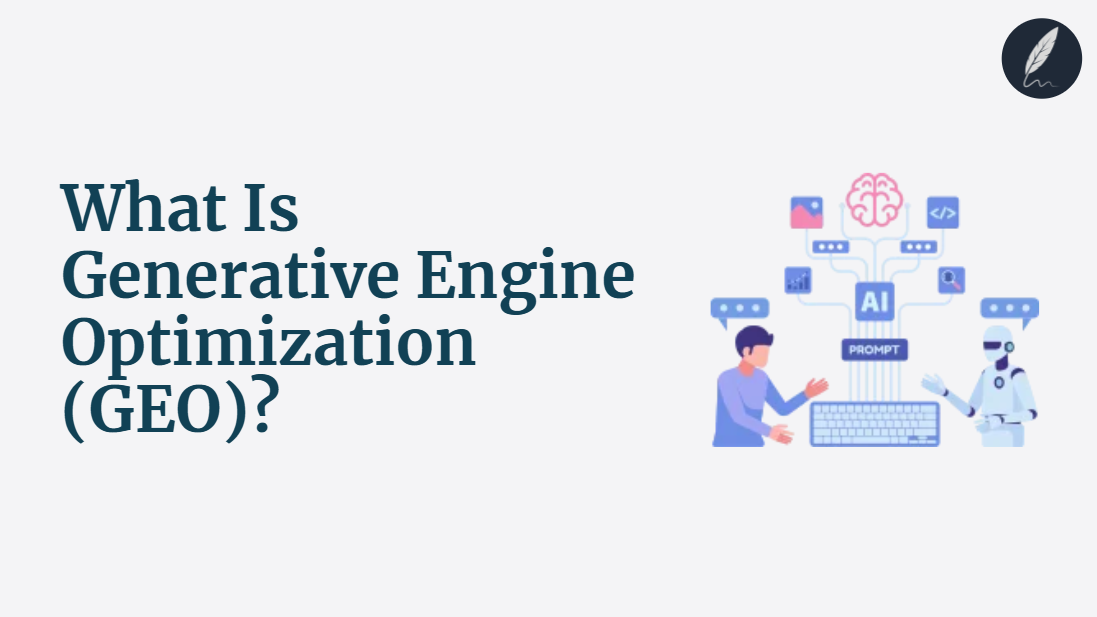
Generative engine optimization (GEO) is an emerging term for improving the likelihood that useful web content is discovered, used, or linked in AI-generated answers. It is a useful working label for AI search optimization, not an official set of rules shared by every platform.
GEO does not replace SEO. Strong SEO still helps search systems find, crawl, index, and understand a page. GEO simply adds another visibility question: can a system use your information confidently when it builds a response, presents supporting links, or names sources?
Documented research finding: The original GEO paper, accepted at KDD 2024, formalized the term and evaluated optimization methods on its own benchmark of 10,000 queries. The authors reported visibility improvements of up to 40% in that benchmark and up to 37% in a Perplexity evaluation.
Those results are useful research evidence, but they are not a promise of citations in Google, ChatGPT, Copilot, or any other product.
The study found that citations, quotations from relevant sources, and statistics could improve source visibility in its tests. The effect varied by query domain and strategy. That limitation matters: writers should treat the findings as a reason to make claims easier to verify, not as a formula for gaming AI citations.
Sensible recommendation: Publish content that gives readers a direct answer, names the people or organizations behind important claims, links to primary evidence, and explains dates, methods, and limits. Keep the page accessible to search systems and review what happens over repeated observations.
For example, “Our software saves time” is difficult to assess. A more sourceable claim would say: “In May 2026, our editorial team tested the software on 24 marketing briefs. Using it for first drafts reduced median revision time by 18%. Results may vary by workflow and reviewer experience.” The second version gives readers a method, scope, date, and limitation to inspect.
How Generative Search Differs From Traditional Result Pages
Map the Path From Discovery to Citation
- Traditional search: People see a page of ranked links, then decide which pages to open, compare, and trust.
- Generative search: The experience may synthesize an answer, show supporting links, and invite follow-up questions in the same interface.
That shift changes what visibility can look like. A useful page may rank in organic search. An AI response may also summarize its information, link to it, mention its brand, or cite it as a source. These are different outcomes, and none is guaranteed by the one before it.
A simple way to separate those outcomes is to follow the path from discovery to attribution:
- Crawled: A search system can fetch the page.
- Indexed: The page can enter the search index.
- Eligible: The page meets the conditions to appear in relevant search features, such as a snippet where required.
- Supporting link: The URL appears beside or within a generated response.
- Mentioned: The response names the company, author, product, or idea.
- Cited or attributed: The system explicitly identifies the page as a source.
Documented platform fact: For Google AI Overviews and AI Mode, Google’s guidance for website owners says a page must be indexed and eligible to show a snippet before it can appear as a supporting link. Google also states that there are no additional technical requirements for that supporting-link eligibility. This describes Google Search, not every AI product.
Google explains that AI Overviews and AI Mode may use query fan-out: related searches across subtopics and data sources can help build a response. For writers, the practical lesson is not to guess every hidden sub-query. Instead, answer the main question clearly, define important terms, and cover the decisions readers need to make.
Unsupported promise: Being crawlable, indexed, or eligible does not guarantee a supporting link, mention, or citation. Generated answers can change with the query wording, location, available sources, product version, and the system’s own choices. Treat these stages as useful observations to measure over time, not as a fixed AI ranking ladder.
GEO vs. SEO vs. AEO vs. Writing for ChatGPT
- Shared foundation: SEO, AEO, GEO, and writing for ChatGPT, all aim to make useful information easier for people and search experiences to find.
- Important difference: Each label emphasizes a different outcome, so no single checklist controls every AI-search surface.
SEO is the broad practice of helping search engines discover, understand, and rank useful pages. Technical health, clear page purpose, helpful information, and topical relevance still matter because they help search systems and readers understand a page before any generative feature enters the picture. For a practical foundation, see Anatomy of a Blog Post That Ranks.
Answer engine optimization (AEO) is a commonly used label for making content easy to answer from, often through direct definitions, concise explanations, and question-led formats. An FAQ can be useful when it answers real reader questions, FAQ Pages for SEO explains how to build one well. Still, an FAQ section alone does not create indexing eligibility or guarantee that an answer engine will use it.
Generative engine optimization (GEO) is the emerging umbrella term for improving visibility in generated answers, supporting links, mentions, and source attribution. It extends the question beyond rankings: is the page useful, accessible, and well supported enough for a system to surface when it builds an answer? In practice, GEO overlaps heavily with sound SEO rather than replacing it.
Writing for ChatGPT means testing and improving content with one product experience in mind. That can reveal useful patterns, such as whether a page is mentioned or linked for a specific query on a specific date. But it cannot predict Google AI Overviews, Microsoft Copilot, Perplexity, or future versions of ChatGPT. For a product-specific next step, read How to Write Content Cited by ChatGPT.
Consider a publisher that updates a guide with expert definitions, dated research, clear internal links, and transparent source notes. The page may improve in organic search, appear as a Google supporting link, or receive a ChatGPT mention.
Those are three separate observations, not evidence of one universal “AI rank.” For Google’s own AI features, Google documents that the foundation remains standard technical eligibility and helpful, reliable content.
What Google Publicly Says About AI Overviews and AI Mode
Start With Standard Search Eligibility and Helpful Content
Google’s public guidance is simple: AI Overviews and AI Mode are part of Google Search, so the same core SEO and content principles still apply. The goal is to make helpful information available through normal Search, not to chase a special switch for generated results.
Documented platform fact: Google’s guide says indexed pages that can show a Search snippet may appear as supporting links in AI Overviews and AI Mode. Google also says there are no additional technical requirements for that supporting-link eligibility.
That statement is narrower than many GEO claims suggest. Indexing and snippet eligibility make a page eligible for consideration. But Google may still not show it as a supporting link, mention its brand, or cite it for a specific query.
Google also advises creators to assess content through three practical questions in its helpful, reliable, people-first content guidance:
- Who created it? Make authorship, experience, and accountability clear.
- How was it created? Explain methods, research, testing, or meaningful use of automation when readers would reasonably expect that context.
- Why does it exist? Publish it to help people make a decision or solve a problem, not simply to attract search traffic.
Sensible recommendation: Treat strong SEO, transparent sourcing, and genuine first-hand expertise as durable foundations for AI search optimization. Use descriptive headings, clear answers, and accessible page content because readers need them, not because any one format can force an AI Overview or AI Mode citation.
Unsupported promise: Special schema, an AI text file, a fixed word count, or a rewritten “AI-friendly” tone does not guarantee visibility in Google’s AI features. Google’s documentation applies to Google Search, ChatGPT, Microsoft Copilot, Perplexity, and other products may use different systems and source-selection methods. The next step is to make each important claim easy for readers to verify.
How to Create Sourceable Content
Make Each Important Claim Easy to Verify
- Make claims inspectable: Readers should be able to see who is making a claim, what evidence supports it, and where its limits begin.
- Set realistic expectations: Sourceable content can make a page more useful and credible, but it does not guarantee an AI citation.
Start with the answer, then give readers the details they need to judge it fairly. Name the organization, method, audience, timeframe, and source behind a meaningful claim. When evidence has limits, state those limits instead of hiding them in vague language.
For example, “AI tools improve content quality” does not give readers much to check. A more sourceable version might say: “Between April and June 2026, our editorial team used an AI tool to draft 30 SaaS blog introductions. Editors reviewed every draft against our style guide. They rated 22 introductions as needing fewer structural revisions. This small internal review does not measure long-term search performance.”
Readers can inspect the use case, sample, timeframe, review method, result, and limitation.
Build Topic Depth Without Padding or Keyword Stuffing
The purpose is to help readers continue learning, not to manufacture topical authority. If a link does not add useful context or a practical next step, it does not need to be there.
- Topic depth: Help readers make the decision behind a query instead of repeating a keyword in slightly different words.
- Useful coverage: Include the definition, relevant subquestions, examples, trade-offs, and next step the reader needs.
- What to remove: Cut sections that add no evidence, distinction, or practical value.
Depth does not mean answering every possible variation of a query. It means giving readers the context they need to understand the subject, weigh trade-offs, and decide what to do next.
Avoid padding a guide simply to sound comprehensive. When a section does not add evidence, a useful distinction, or a practical next step, removing it usually gives the reader a clearer answer.
Use clear language, and add related resources only when they extend the answer. For example, a broad GEO guide can link to Content Clusters for topic architecture, What Is Readability? for clear writing, and LSI Keywords for using related language naturally. These links should help a reader continue learning, not manufacture topical authority.
Cover the Technical Basics That Make Content Accessible
Technical basics support the same goal: make your useful information available to people and search systems. Before publishing, check that the main answer can be accessed, understood, and reached through relevant pages on your site.
- Make the page reachable: Helpful evidence cannot do much if readers or search systems cannot access it.
- Keep key content accessible: Important pages should be crawlable, indexable, internally linked, and available as readable HTML rather than hidden behind a login, image, or script-dependent interaction.
- Use a preferred version: A canonical URL helps signal which version of a page should be treated as the preferred one.
- Check eligibility: For Google AI Overviews and AI Mode, Google says a page must be indexed and eligible to show a Search snippet before it can appear as a supporting link.
- Check access and discovery: Make sure the main answer loads as page text without a login, and add descriptive internal links from relevant pages.
- Keep expectations realistic: Canonicals, schema, robots controls, and AI-specific files may serve other purposes, but none guarantees a mention or citation.
Compact Checklist for Citation-Ready Content
- Answer the main question early: Give readers a plain-language answer before adding background, examples, or exceptions.
- Name the subject clearly: Define important terms, products, organizations, methods, and people rather than relying on vague references.
- Show where important claims come from: Link to primary sources where possible, or identify the first-hand evidence and the organization responsible for it.
- Add context to results: Include the date, sample, method, scope, and meaningful limitation behind statistics, tests, and performance claims.
- Make the page easy to follow: Use descriptive headings, short paragraphs, and lists only where they help readers scan a process or comparison.
- Use links with purpose: Add internal or external links when they provide supporting evidence, useful context, or a clear next step.
- Check technical access: Confirm that the main content is crawlable, indexable, available as readable HTML, and associated with the preferred canonical URL.
- Remove weak claims: Review for repeated statements, unsupported superlatives, unnamed sources, and claims that readers cannot reasonably verify.
- Sensible recommendation: Treat this as a quality, clarity, and accessibility review, not a formula that guarantees an AI answer, supporting link, or citation.
Run a 30-Day GEO Experiment Instead of Chasing Screenshots
A 30-day GEO experiment gives you a more useful signal than a collection of favorable screenshots. It helps you record a baseline, make a limited set of reader-focused improvements, and review what occurs repeatedly across the same queries.
Week 1: Choose a Small, Repeatable Query Set
- Choose realistic questions: Select 10–20 informational queries that map to pages you own or can improve.
- Include useful variation: Combine core questions, comparison questions, and natural follow-ups.
- Avoid vanity prompts: Do not use prompts designed only to make your brand appear.
Create a simple log with the exact query, date, platform, region or language setting, observed page, result type, URL, notes, and follow-up action. Capture a baseline across several sessions or days, then keep the query set stable for the month.
Generated answers can vary, so a single screenshot is an anecdote rather than a trend; document unavoidable changes in product version, location, or settings as they occur.
Weeks 2–3: Make Small, Documented Content Changes
- Limit the pages: Improve a small group of relevant pages rather than changing the whole site.
- Make inspectable updates: Clarify answers, add named sources, date statistics, explain methods, state limits, improve links, or correct indexing issues.
- Document each change: Record the update, publication date, reviewer, source added, and reason.
Change only a few meaningful variables at once. If you rewrite the page, redesign the site, migrate URLs, and launch a link campaign in the same week, you cannot reasonably tell what influenced the result.
For example, a fictional SaaS guide could replace an unlinked performance claim with dated primary documentation and a clear limitation, then track the same queries over several observations. One citation after publication is an observation, not proof of a “citation optimization” win.
Week 4: Review Patterns and Decide What to Test Next
- Repeat the same test: Rerun the original query set across several sessions using the recorded settings.
- Compare outcomes: Track whether a page was observed, linked, mentioned, attributed, visited, or associated with a conversion.
- Record conditions: Note changed wording, competing sources, unavailable features, and missing generated answers.
Documented platform fact: Google reports traffic from AI features within the Web search type in Search Console, according to its AI features guidance. Use analytics to review engagement and conversions after a click, then keep a brief learning log of what changed, what repeated, what remains uncertain, and what you will test next.
The experiment should inform better content decisions, not create a universal AI-search ranking score. A missed citation does not prove a page is poor, and a repeated citation does not prove it will persist.
Measure GEO Visibility With Repeated Observations
Separate Exposure, Attribution, Traffic, and Business Outcomes
- Measure outcomes separately: GEO visibility is not one metric or a universal AI rank. A page may appear as a supporting link, earn a brand mention, receive explicit source attribution, generate a referral visit, or contribute to a conversion. Each outcome answers a different question, so measure them separately.
Start with exposure and attribution. A supporting link means your URL appears beside or within a generated response. A mention means the response names your company, product, author, or idea, with or without a link. Attribution is narrower: the system explicitly identifies your page as a source. Record the exact query, date, platform, destination URL, and how the result appeared.
Then measure what happens after a click. Use analytics to review referral visits, engaged sessions, sign-ups, leads, sales, or another outcome that matters to your business. Visibility can still build awareness when no one clicks, but awareness is not the same as measurable traffic or commercial impact.
Repeat the same queries across several dates and, where relevant, platforms. Note changes in prompt wording, location, language, logged-in state, product version, available sources, and whether a generated answer appeared at all. A single screenshot captures one moment, repeated observations reveal whether a pattern is worth investigating.
Platform reporting needs the same care. Google states that traffic from its AI features is included in the Web search type in Search Console, as explained in its AI features guidance. Review the Bing Webmaster Blog for Bing’s evolving guidance, but treat every dashboard’s definitions, coverage, and metrics as platform-specific and subject to change.
Sensible recommendation: Keep a simple measurement log that connects the query, observed result, referral data, content change, and follow-up decision. Do not turn a citation, mention, or supporting link into a universal ranking score. Repeated visibility is a useful signal to test, not proof that an outcome will persist.
Review Sourceability and Clarity in Orwellix
Review Your Draft Before Publishing
- Review the complete draft: Before publishing, use Orwellix as a workspace to review the complete draft.
- Check the evidence and writing: Live research can help you find current supporting sources, while Agent Mode can help you review clarity, evidence gaps, repetition, structure, and readability in context.
Every suggested edit is tracked, so you can review it, approve it, reject it, or refine it before publishing. That keeps the writer in control while making it easier to document the improvements behind a stronger, more sourceable article.
Orwellix is not an AI-citation machine. It cannot guarantee an appearance in AI answers, supporting links, mentions, or citations. Instead, use the citation-ready checklist and 30-day experiment to review one existing article, make focused improvements, and record what you learn over time.

Write smarter with Orwellix
The Orwellix AI Capabilities that helps you craft clearer, more effective content.
Conclusion
Generative engine optimization is not a shortcut to AI citations. It builds on strong SEO, clear answers, trustworthy evidence, accessible pages, and useful topic coverage. When readers can understand, verify, and act on your content, search systems have a better foundation for finding and using it.
The next step is to test thoughtfully. Track supporting links, mentions, traffic, and conversions over time instead of relying on one screenshot or one citation.
Use a practical review process, such as Orwellix’s tracked research and editing workflow, to strengthen an article without surrendering editorial control. AI search will keep changing, but useful, well-supported content will remain worth publishing.
Frequently Asked Questions (FAQs)
1. Does generative engine optimization replace SEO?
No. GEO builds on SEO by focusing on whether useful, accessible content may also be used in generated answers. Strong SEO still helps search systems discover, index, and understand your pages.
2. Can GEO guarantee an AI citation or supporting link?
No. Clear, well-supported content may improve its usefulness, but no tactic guarantees an AI citation, mention, or supporting link. Results can change with the query, location, available sources, and product version.
3. What does a page need to appear in Google AI Overviews or AI Mode?
For a page to be eligible as a supporting link, Google says it must be indexed and eligible to show a Search snippet. Google does not list extra technical requirements for this eligibility, but eligibility does not ensure inclusion for any query.
4. What makes content easier for AI search systems to use?
Make important claims easy to verify. Give a direct answer, name the source, include relevant dates and methods, and explain meaningful limits. This also helps readers judge whether your information is trustworthy.
5. Do schema markup or AI-specific files improve GEO results?
They may serve useful technical purposes, but they do not guarantee AI-search visibility or citations. Prioritize crawlable, indexable pages with readable content, helpful internal links, and reliable evidence before chasing a special GEO shortcut.
6. How should I measure GEO performance?
Track supporting links, mentions, source attribution, referral visits, and conversions as separate outcomes. Repeat the same queries over time and record the platform, date, settings, and content changes, because one screenshot is not a reliable trend.
Try Orwellix Free for 7 Days
Experience Orwellix AI Agent's capabilites with risk-free trial. Full access to all features for 7 days. Credit card required to start, you won't be charged until the trial ends.
Start Your Free Trial