For a general adult audience, a Flesch Reading Ease of 60 or above, which Flesch's own table maps to 8th to 9th grade reading, and which Microsoft Word and most style guides restate as a 60 to 70 target. Health materials aim lower, at 5th to 6th grade; business and academic readers tolerate grade 12; US insurance law sets a floor of 40, 45 or 50 depending on the state. Every number on this page is traced to the document that said it, and the second half explains why any score should be read as a range of about ±1.5 grades, not a point.
40 · 45 · 50Flesch minimums in US insurance law: NAIC model, Florida and New York, Maine and Massachusetts
Three things change how to read those numbers. The formulas were calibrated on school reading lessons from 1926 and 1961 and on Navy manuals in 1974, so a "grade" is a historical yardstick, not a measurement of your readers[3][5]. The same text gets different grades from different formulas, routinely two to four apart, and different tools disagree even on the same formula[17][18]. And the bodies that publish targets say, in their own guidance, that a score is a rough guide and that testing with readers is the real check[28][40]. The tables below give you the numbers, their sources and their limits together.
02
The seven formulas
Whateachformulacounts,andwhoitwasbuiltfor.
Equations as published, from the primary texts where we could open them. Two are marked secondary because the original papers could not be opened; the table says so rather than guessing.
The seven readability formulas: equation, inputs, scale, origin
Sentence length and the share of "hard words" of three or more syllables, excluding proper names, compounds of short words, and verbs made long by -ed or -es
Years of schooling; 12 is Gunning's "danger line"
Business, newspaper and government writers; calibrated on magazine samples and school lessons
Characters per word ("typewriter strokes") and words per sentence
US school grade
US Air Force technical material, counted live on a modified typewriter
SMOG
1969
3 + √(polysyllabic words in 30 sentences)
Count of words with three or more syllables in a fixed 30 sentences, repeats included; multiplies word length by sentence length instead of adding them
US grade needed for complete comprehension
General prose; the grade at which a reader understands everything
Sentence length and syllables per word, refitted to predict a grade directly
US school grade
US Navy enlisted personnel reading Rate Training Manuals
Coleman-Liau Index equation from secondary sources
1975
0.0588 × L − 0.296 × S − 15.8, with L = letters per 100 words and S = sentences per 100 words
Letters per word and sentences per word; built so a scanner only has to find character, word and sentence boundaries
US school grade
Machine scoring of school texts
New Dale-Chall equation from secondary sources
1995
0.1579 × (unfamiliar words ÷ words × 100) + 0.0496 × (words ÷ sentences), + 3.6365 when unfamiliar words exceed 5%
Share of words not on a familiar-word list of about 3,000 words, plus sentence length
Raw score mapped to grade bands (4.9 and under = grade 4 or below; 9.0 and over = college)
School texts from grade 4 up
Showing 7 of 7 rowsOpen a row for the sample it was validated on, the authors' own caveats and where it is used today.
03
The conversion chart
Fleschscoretograde,inFlesch'sownwords.
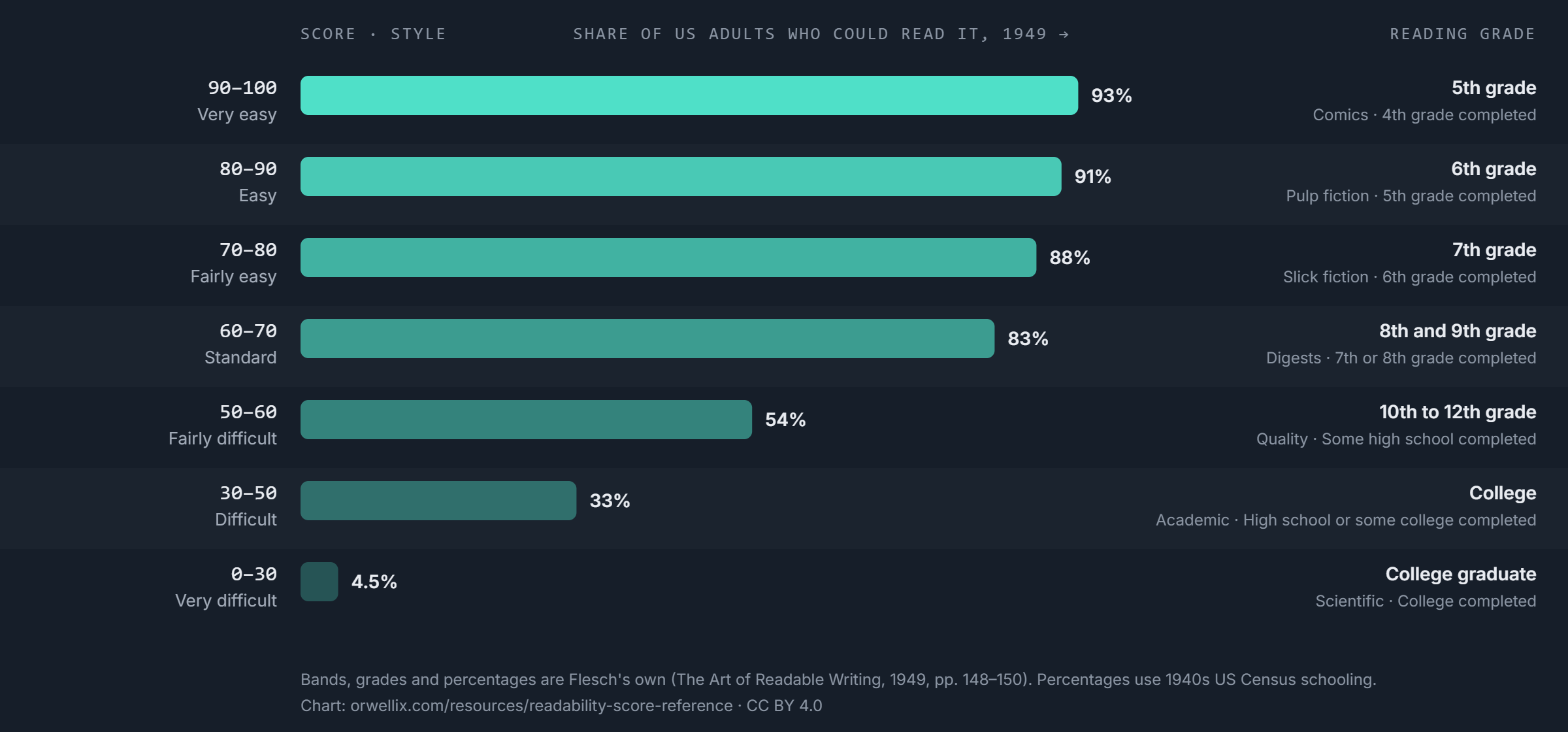
Everyone reproduces this table; almost nobody cites it. It is from The Art of Readable Writing (1949), pages 148 to 150, with the percentages Flesch attached from the US Census.
Flesch Reading Ease, 1949 bands
Score band, style label, estimated reading grade, and the share of US adults Flesch estimated could read it
The bar is Flesch's estimate of the share of US adults, by school grades completed in the 1940 Census, who could read text in that band. A score of 62 is "8th or 9th grade reading"; 45 is "college-level reading" (p. 148).
60–70Standard · 8th and 9th grade · 7th or 8th grade completed · 83% of adults · typical: Digests
50–60Fairly difficult · 10th to 12th grade · Some high school completed · 54% of adults · typical: Quality
30–50Difficult · College · High school or some college completed · 33% of adults · typical: Academic
0–30Very difficult · College graduate · College completed · 4.5% of adults · typical: Scientific
04
Targets by content type
Whorecommendswhat,andwhich formulatheymean.
34 recommendations, standards, laws and measurements. Filter by sector. Each row names the body, the year and the formula it refers to, because a "grade 8" from one formula is not a grade 8 from another.
Readability targets by content type with source
Recommendation
Formula named
Consumer web, homepage and landing pages
6th grade
None named
Nielsen Norman Group 2005 · Guidance
Consumer web, general
8th grade
Flesch-Kincaid in Word; "it doesn't really matter which formula you use"
Nielsen Norman Group 2015 · Guidance
B2B and college-educated audiences
12th grade
Flesch-Kincaid
Nielsen Norman Group 2015 · Guidance
Any page, accessibility level AAA
Lower secondary (about years 7 to 9) or a simpler version
None named
W3C, WCAG 2.2 SC 3.1.5 2026 · Standard
Microsoft Word default advice
Reading Ease 60 to 70; grade 7 to 8
Flesch Reading Ease and Flesch-Kincaid
Microsoft Support 2026 · Tool convention
US federal public content
No score or grade. "Clear, concise, well-organized"; test with users
None
Plain Writing Act of 2010; digital.gov guide 2010 · Law and guidance
US securities disclosure
No formula; every formula has "a major flaw"
None
SEC Plain English Handbook 1998 · Guidance
UK government services
Reading age 9
None named
GOV.UK content design 2022 · Guidance
UK Home Office content, including specialist
Maximum reading age 9
Points to Word's reading-age checker
Home Office design manual 2026 · Guidance
NHS health content
No score; tools only to prioritise, then test with users
None recommended
NHS digital service manual 2023 · Guidance
Patient education materials
5th or 6th grade; 3rd to 5th for high-risk practices
Flesch-Kincaid in Word, with caveats
AMA Foundation (Weiss) 2007 · Guidance
Patient education materials
6th grade or lower
None named
American Family Physician 2005 · Guidance
Health materials, universal precautions
4th or 6th grade "as recommended"
Fry, SMOG, Flesch Reading Ease
AHRQ Tool 11 2024 · Guidance
Medicare and Medicaid materials
No target grade. Do not use formulas to judge suitability; interpret scores as broad ranges
Fry or SMOG if you must score
CMS Toolkit, Part 7 2010 · Guidance
Public health materials
No numeric target; comprehension is often two or more grades below reading level
Flesch-Kincaid, Fry, Fog, SMOG listed
CDC Simply Put 2010 · Guidance
Public health materials
Score 90 or above on the 20-item index
Own index, not a formula
CDC Clear Communication Index 2014 · Standard
Health materials, general audiences
8th grade or lower
SMOG
Harvard T.H. Chan School of Public Health 2026 · Guidance
Life and health insurance policies, model law
Reading Ease 40 minimum
Flesch Reading Ease, with the computation written into the law
NAIC Model Act 575 1978 · Law
Insurance policies, Florida, New York, Connecticut, Michigan
Reading Ease 45 minimum
Flesch Reading Ease
State statutes 2025 · Law
Insurance policies, Maine, Massachusetts, North Carolina, Colorado
Reading Ease 50 minimum; Colorado also caps at 10th grade
Flesch Reading Ease; Flesch-Kincaid in Colorado
State statutes 2025 · Law
Financial privacy notices, measured
Measured at grade 15.6 (3rd to 4th year of college)
Flesch Reading Ease
Hochhauser, Privacy Rights Clearinghouse 2001 · Measurement
Health website privacy policies, measured
Measured at Reading Ease 39, SMOG 14.7, Fry 14.6
Flesch Reading Ease, SMOG, Fry
Graber et al., Journal of Family Practice 2002 · Measurement
Informed consent, federal rule
No grade. Language "understandable to the subject"
None
21 CFR 50.20; 45 CFR 46.116 (as explained by UAMS IRB) 2014 · Law
Informed consent, institutional policies
8th grade or below
Word-processor scores
UAMS, University of South Carolina, LSU Pennington IRBs 2016 · Policy
Informed consent templates, measured
Measured at grade 10.6; institutional standards range 5th to 10th
Flesch-Kincaid
Paasche-Orlow et al., NEJM 2003 · Measurement
Informed consent, plain-language template
Template at 5th grade; adopters' consents at 7th; previous mean 10th
Flesch-Kincaid, SMOG, Fry
Moore et al., J Clin Transl Sci 2018 · Measurement
Scientific abstracts, measured
Share with Reading Ease below 0 rose from 14% (1960) to 22% (2015)
Flesch Reading Ease; New Dale-Chall
Plavén-Sigray et al., eLife 2017 · Measurement
Academic and scientific prose, Flesch's scale
30 to 50 college; 0 to 30 college graduate
Flesch Reading Ease
Flesch, How to Write Plain English 1979 · Benchmark
Magazines, Flesch's benchmarks
Reader's Digest 65; Time 52
Flesch Reading Ease
Flesch, How to Write Plain English 1979 · Benchmark
Magazines, Gunning's scale
Fog 10 Reader's Digest; 11 Time and Newsweek; 12 Atlantic and Harper's; 13 is the "danger line"
Gunning Fog
Gunning, The Technique of Clear Writing 1968 · Benchmark
Web copy, SEO
Reading Ease around 60; "a guide, not a rule"
Flesch Reading Ease
Yoast 2025 · Tool convention
General writing
Grade 9 default target
None named
Hemingway Editor help 2026 · Tool convention
Marketing email
6th to 8th grade
Flesch-Kincaid, Fog, SMOG, Coleman-Liau named
Mailchimp 2026 · Tool convention
School texts, Common Core bands
Grade 8: 1010L to 1185L; grades 11 to 12: 1185L to 1385L
Lexile (word frequency and sentence length)
MetaMetrics, citing CCSS Appendix A 2012 · Standard
Showing 34 of 34 rows"Measurement" rows report what documents actually scored, not what anyone recommends.
US insurance readability statutes
The one place a readability score is the law. The NAIC model act of 1978 wrote Flesch's computation into statute with a minimum of 40; states adopted it and some raised the floor[10][11]. Rows marked "from NAIC chart" rest on the NAIC's Summer 2025 compilation rather than the statute text.
US insurance policy readability minimums by jurisdiction
41 state and DC entries in the chart name a Flesch score; 40 is the most common minimum.
Showing 11 of 11 rows
05
Worked example
Onepassage,sevenanswers.
A 100-word business passage scored by six formulas and by Orwellix. The spread is the point: report the formula with the score, and never compare a Fog number with a Flesch-Kincaid one.
Our team reviewed the quarterly report before the meeting. Several figures had been revised by the finance department, so we compared the new totals with last year's numbers. The marketing budget grew by twelve percent, which was expected after the product launch. Customer complaints, however, rose at the same time, and nobody could explain why. We agreed to interview twenty recent customers and to examine the support tickets from the past three months. The findings will be presented next Friday. If the pattern holds, we will recommend a change to the onboarding process rather than another increase in advertising spend.100 words · 7 sentences · 14.3 words per sentence · 1.58 syllables per word · 14 words of 3+ syllables
Flesch Reading Ease58.7Fairly difficult (Flesch band 50 to 60)
Flesch-Kincaid Grade8.6Grade 9
Gunning Fog11.3Grade 11
SMOG11.2Grade 11, on a sample too short for the formula
Coleman-Liau12.4Grade 12
ARI9.9Grade 10
Orwellix readability grade5.9Very easy
The six formulas place the same seven sentences anywhere from grade 8.6 to grade 12.4. The spread is normal: SMOG predicts complete comprehension and runs high, Coleman-Liau and ARI count letters and are pulled up by words like "department" and "onboarding", and Flesch-Kincaid was fitted to a population that found Navy manuals a grade easier than the originals did[3][5]. Orwellix reads the passage as very easy, at grade 5.9, with 0 hard sentences; 5 writing-style flags, including the two passive constructions: it treats 14-word sentences of everyday words as easy regardless of their syllable count, and flags the passives separately instead of folding them into a length score. Dale-Chall is not shown because it needs the proprietary word list. Formula scores were computed with a plain implementation and a heuristic syllable counter; another tool will differ by a point or two, which is part of the lesson.
06
What the formulas miss
Nine findingstokeepbesideanyscore.
Peer-reviewed measurements of how well the formulas do, and the rules their own authors set that most tools ignore.
Seven of eight formulas were less than 49% accurate at predicting which pupils could read a passage; the worst was 17% accurate, the best 79%. One passage was rated anywhere from grade 1 to grade 5 depending on the formula.[19]
360 pupils in grades 2 to 5, each reading six passages aloud.
On about 5,000 excerpts rated by teachers, classic formulas explained only 23% to 34% of the variation in difficulty. A model with 28 language features explained 51%.[20]
Flesch-Kincaid itself was fitted to 18 Navy training passages.
The same text scored with the same formula varied by up to 12.9 grade levels across eight calculators. Only Microsoft Word agreed with hand scoring for Flesch-Kincaid, and only two of four tools for SMOG.[18]
Preparing the text to formula rules removed 4% to 25% of the content of health web pages.
Across formulas, one health text varies by up to 5 grade levels; within one formula, sample size, sampling spot, formatting and software add up to 6 grades of spread.[17]
The review recommends reporting sample size, location and method with any score.
A word-shuffled paragraph scores the same as the original, and the opening propositions of Wittgenstein's Tractatus score below grade 8 on four formulas.[61]
Formulas count; they do not read. Short sentences of hard content pass.
Formulas disagree with each other by design: Gunning excludes proper names and -ed verbs from hard words, McLaughlin counts "any string of letters or numerals" including repeats.[4]
Few tools implement Gunning's exclusions, which is one reason their Fog numbers differ.
SMOG needs 30 sentences, about 600 words, and is right within 1.5 grades only 68% of the time. Fog was designed for 100-word samples, which McLaughlin called "so small that it may be quite uncharacteristic".[5]
Most online checks score a shorter passage than either author allowed.
Lists, headings and tables break the formulas: ending list items with a period, or not, changes the score, and a page that is mostly fragments cannot be graded at all.[62]
The SEC noted that by some formulas Einstein's relativity reads at a 5th grade level.
Official bodies say the same thing in their own words: NN/g calls the counts "only an approximation of what really matters"; the CDC says formulas "do not measure a persons' level of comprehension"; CMS warns that a grade-level requirement "has the potential to do harm".[28]
The current US federal plain-language guide does not mention a formula; it recommends testing with readers.
The formulas count two things because that was what could be counted by hand in 1948. Orwellix's readability analysis scores four dimensions of every sentence. Each has evidence behind it that it changes how people read.
01
Structural complexity
What it reads: Sentence length, clause depth and how far apart the words that depend on each other sit.
Evidence: Distance, not length, is what costs readers: integration and memory cost rise with the span between dependent words, and surprisal predicts reading time word by word in eye-tracking corpora.[56][64]
Seen in Orwellix as: Red and yellow sentence highlights and their explanations
02
Lexical sophistication
What it reads: How rare, unfamiliar or late-acquired the words are, not only how many syllables they have.
Evidence: Word frequency, familiarity, length, concreteness and age of acquisition all change how long the eye stays on a word; frequency and familiarity act early and keep acting, length only once re-reading starts.[55]
Seen in Orwellix as: Vocabulary reasons and the grade-level result
03
Writing clarity
What it reads: Patterns that weaken direct expression: passive voice, nominalisations, negatives, qualifiers and adverbs.
Evidence: Passives are often misread even by skilled adults, and in jury-instruction studies the rewrite with the biggest drop in passive rate raised correct understanding from 61% to 82%.[58][59]
Seen in Orwellix as: Blue writing-style highlights and counts
04
Text coherence
What it reads: How sentences connect: referential overlap, connectives, causal links.
Evidence: Coherence improves comprehension, misplaced connectives slow the next sentence, and in Coh-Metrix referential and causal cohesion are two of the five factors that explain most of the variation between texts across grade levels.[65][60][57]
Seen in Orwellix as: The overall readability assessment
The output is still one grade level with colour-coded sentences, so it reads like a formula score. The difference is what moves it. A passage of short sentences full of rare terms scores "easy" on every formula and hard on a lexical measure; a long sentence whose clauses sit next to each other scores hard on length and easy on structure. The research behind modern readability work says the same: on about 5,000 teacher-rated excerpts, classic formulas explained 23% to 34% of the difficulty and a 28-feature model explained 51%[20], and model-based measures now rank above every classic formula against human judgments[26][27]. Orwellix does not publish a competing formula; it publishes sentence-level feedback you can act on, and this page so you can see what the formula numbers are and are not.
08
Method, limitations, data
Howthispagewasbuilt,andwhatitcannottellyou.
Method
One rule: a figure reaches the page only after a person opened the document that said it, on 23 Oct 2026. Formulas were taken from the primary texts: Flesch's 1949 book, the 1975 Navy report, Gunning's 1968 revised edition and McLaughlin's 1969 article, all read in full from library scans.
Targets were collected from the publishing body's own page or PDF, with the formula it names recorded beside it.
Insurance thresholds come from the NAIC model act and chart, with four state statutes opened directly.
The worked example uses a plain implementation of each formula with a heuristic syllable counter, and Orwellix's free readability checker for the four-dimension grade.
Limitations
Coleman-Liau and Dale-Chall are marked secondary: the 1975 article and the 1948 and 1995 texts could not be opened, so their constants come from reference works.
The GOV.UK "reading age 9" line was verified only in an archived 2022 copy; the live page has moved.
NIH's own reading-level wording could not be reached; the "AMA and NIH say 6th grade" claim is verified on the AMA side only.
Flesch's adult percentages are 1940s Census estimates and are shown as history, not as current literacy data. Current figures: 28% of US adults aged 16 to 65 scored at Level 1 or below in literacy in PIAAC 2023, up from 19% in 2017[53][54].
Tables and charts are CC BY 4.0: reuse them with a link to this page.
09
Sources
67documents,eachoneopened.
Primary texts first, then the guidance, laws and studies the tables cite. Numbers match the superscripts above.
Flesch, R. (1948). A new readability yardstick. Journal of Applied Psychology, 32(3), 221–233. doi:10.1037/h0057532 (citation verified; article paywalled). SourceOpened 23 Oct 2026
Flesch, R. (1949). The Art of Readable Writing. Harper & Brothers, New York. Full scan, Digital Library of India via archive.org. SourceOpened 23 Oct 2026
Kincaid, J. P., Fishburne, R. P., Rogers, R. L., & Chissom, B. S. (1975). Derivation of new readability formulas (Automated Readability Index, Fog Count and Flesch Reading Ease Formula) for Navy enlisted personnel. Research Branch Report 8-75, Naval Air Station Memphis. Full text, University of Central Florida STARS. SourceOpened 23 Oct 2026
Gunning, R. (1968). The Technique of Clear Writing, revised edition. McGraw-Hill (first edition 1952). Full scan via archive.org. SourceOpened 23 Oct 2026
McLaughlin, G. H. (1969). SMOG grading: a new readability formula. Journal of Reading, 12(8), 639–646. Full scan hosted by Ohio State University. SourceOpened 23 Oct 2026
Coleman, M., & Liau, T. L. (1975). A computer readability formula designed for machine scoring. Journal of Applied Psychology, 60(2), 283–284. doi:10.1037/h0076540 (citation verified; text not opened). SourceOpened 23 Oct 2026
Smith, E. A., & Senter, R. J. (1967). Automated Readability Index. AMRL-TR-66-220, Aerospace Medical Research Laboratories, Wright-Patterson AFB (not reachable on the day; constants verified in source 3). SourceOpened 23 Oct 2026
Chall, J. S., & Dale, E. (1995). Readability Revisited: The New Dale-Chall Readability Formula. Brookline Books. Original: Dale & Chall (1948), Educational Research Bulletin, 27(1), 11–20 and 27(2), 37–54 (neither opened; details secondary). SourceOpened 23 Oct 2026
Microsoft Support (2026). Get your document's readability and level statistics. Support article for Word. SourceOpened 23 Oct 2026
National Association of Insurance Commissioners (1995). Life and Health Insurance Policy Language Simplification Model Act (Model 575). Adopted 1978; text dated April 1995. SourceOpened 23 Oct 2026
National Association of Insurance Commissioners (2025). Readability Requirements chart (MC-25), Summer 2025. Model Laws, Regulations, Guidelines and Other Resources. SourceOpened 23 Oct 2026
Florida Legislature (2026). Florida Statutes §627.4145, Readable language in insurance policies. SourceOpened 23 Oct 2026
New York State Senate (2026). Insurance Law §3102, Requirements for the use of readable and understandable insurance policies. SourceOpened 23 Oct 2026
Maine Legislature (2026). 24-A M.R.S. §2441, Minimum policy language simplification standards. SourceOpened 23 Oct 2026
Centers for Disease Control and Prevention (2010). Simply Put: a guide for creating easy-to-understand materials, 3rd edition. CDC Stacks. SourceOpened 23 Oct 2026
Harvard T.H. Chan School of Public Health, Center for Health Communication (2026). SMOG readability formula: your tool for clearer health communication. SourceOpened 23 Oct 2026
Wang, L. W., Miller, M. J., Schmitt, M. R., & Wen, F. K. (2013). Assessing readability formula differences with written health information materials: application, results, and recommendations. Research in Social and Administrative Pharmacy, 9(5), 503–516. doi:10.1016/j.sapharm.2012.05.009 (abstract). SourceOpened 23 Oct 2026
Mac, O. A., Ayre, J., Bell, K., McCaffery, K., & Muscat, D. M. (2022). Comparison of readability scores for written health information across formulas using automated vs manual measures. JAMA Network Open, 5(12), e2246051. doi:10.1001/jamanetworkopen.2022.46051 (full text). SourceOpened 23 Oct 2026
Begeny, J. C., & Greene, D. J. (2014). Can readability formulas be used to successfully gauge difficulty of reading materials?. Psychology in the Schools, 51(2), 198–215. doi:10.1002/pits.21740 (abstract and NC State release). SourceOpened 23 Oct 2026
Crossley, S., Heintz, A., Choi, J. S., Batchelor, J., Karimi, M., & Malatinszky, A. (2023). A large-scaled corpus for assessing text readability. Behavior Research Methods, 55(2), 491–507. doi:10.3758/s13428-022-01802-x (full text, PMC10027808). SourceOpened 23 Oct 2026
Zhou, S., Jeong, H., & Green, P. A. (2017). How consistent are the best-known readability equations in estimating the readability of design standards?. IEEE Transactions on Professional Communication, 60(1), 97–111. doi:10.1109/TPC.2016.2635720 (record and summary). SourceOpened 23 Oct 2026
Bruce, B., Rubin, A., & Starr, K. (1981). Why readability formulas fail. Reading Education Report No. 28, Center for the Study of Reading. ERIC ED205915 (abstract). SourceOpened 23 Oct 2026
Redish, J. (2000). Readability formulas have even more limitations than Klare discusses. ACM Journal of Computer Documentation, 24(3), 132–137. doi:10.1145/344599.344637 (abstract). SourceOpened 23 Oct 2026
Kandula, S., & Zeng-Treitler, Q. (2008). Creating a gold standard for the readability measurement of health texts. AMIA Annual Symposium Proceedings, 2008, 353–357 (full text, PMC2655974). SourceOpened 23 Oct 2026
Zheng, J., & Yu, H. (2017). Readability formulas and user perceptions of electronic health records difficulty: a corpus study. Journal of Medical Internet Research, 19(3), e59. doi:10.2196/jmir.6962 (abstract). SourceOpened 23 Oct 2026
Trott, S., & Rivière, P. (2024). Measuring and modifying the readability of English texts with GPT-4. Proceedings of TSAR 2024, 126–134. doi:10.18653/v1/2024.tsar-1.13 (abstract). SourceOpened 23 Oct 2026
Belem, C., Glenn, P., Samuel, V., Kumar, A., & Liu, Y. (2025). Readability reconsidered: a cross-dataset analysis of reference-free metrics. arXiv:2510.15345 (abstract). SourceOpened 23 Oct 2026
Nielsen, J. (2015). Legibility, readability, and comprehension: making users read your words. Nielsen Norman Group. SourceOpened 23 Oct 2026
Nielsen, J. (2005). Lower-literacy users: writing for a broad consumer audience. Nielsen Norman Group. SourceOpened 23 Oct 2026
W3C Web Accessibility Initiative (2026). Understanding Success Criterion 3.1.5: Reading Level (Level AAA). WCAG 2.2. SourceOpened 23 Oct 2026
United States Congress (2010). Plain Writing Act of 2010, Public Law 111-274. govinfo.gov. SourceOpened 23 Oct 2026
Digital.gov (General Services Administration) (2026). Plain language guide: test for understanding. Current home of the federal plain language guidelines (plainlanguage.gov redirects here). SourceOpened 23 Oct 2026
US Securities and Exchange Commission (1998). A Plain English Handbook. Chapter 9. SourceOpened 23 Oct 2026
Government Digital Service (2022). Writing for GOV.UK. GOV.UK content design guidance, archived copy of the 5 May 2022 version (the live page has moved). SourceOpened 23 Oct 2026
UK Home Office (2026). Readability. User-Centred Design Manual, accessibility: written content. SourceOpened 23 Oct 2026
NHS (2023). Health literacy. NHS digital service manual, updated October 2023. SourceOpened 23 Oct 2026
Weiss, B. D. (2007). Health literacy and patient safety: help patients understand. Manual for clinicians, 2nd edition. AMA Foundation and American Medical Association (hosted copy). SourceOpened 23 Oct 2026
Safeer, R. S., & Keenan, J. (2005). Health literacy: the gap between physicians and patients. American Family Physician, 72(3), 463–468. SourceOpened 23 Oct 2026
Agency for Healthcare Research and Quality (2024). Tool 11: assess, select, and create easy-to-understand materials. Health Literacy Universal Precautions Toolkit, 3rd edition, reviewed April 2024. SourceOpened 23 Oct 2026
Centers for Medicare & Medicaid Services (McGee, J.) (2010). Toolkit for Making Written Material Clear and Effective, Part 7: Using readability formulas: a cautionary note. September 2010. The cms.gov copy is gone; read from the full toolkit hosted by the Leapfrog Group. SourceOpened 23 Oct 2026
Centers for Disease Control and Prevention (2014). Clear Communication Index score sheet. Revised July 2014. SourceOpened 23 Oct 2026
University of Arkansas for Medical Sciences IRB (2014). True or false: federal regulations require consent forms to be written at an 8th grade reading level?. IRB blog, 8 September 2014. Also: University of South Carolina consent guidelines (2016); LSU Pennington IRB guidance. SourceOpened 23 Oct 2026
Paasche-Orlow, M. K., Taylor, H. A., & Brancati, F. L. (2003). Readability standards for informed-consent forms as compared with actual readability. New England Journal of Medicine, 348(8), 721–726. PMID 12594317 (abstract). SourceOpened 23 Oct 2026
Moore, T., James, L. P., Holland, J., Paal, E., & Hadden, K. (2018). "Understandable to the subject": plain language IRB informed consents. Journal of Clinical and Translational Science, 1(S1), 52–53 (PMC6799336). SourceOpened 23 Oct 2026
Plavén-Sigray, P., Matheson, G. J., Schiffler, B. C., & Thompson, W. H. (2017). The readability of scientific texts is decreasing over time. eLife, 6, e27725. SourceOpened 23 Oct 2026
Flesch, R. (1979). How to Write Plain English, chapter 2. Harper & Row (hosted copy of the chapter). SourceOpened 23 Oct 2026
Hochhauser, M. (2001). Lost in the fine print: readability of financial privacy notices. Privacy Rights Clearinghouse. SourceOpened 23 Oct 2026
Graber, M. A., D'Alessandro, D. M., & Johnson-West, J. (2002). Reading level of privacy policies on internet health web sites. Journal of Family Practice, 51(7), 642–645. SourceOpened 23 Oct 2026
Yoast (Reid, B.) (2025). The Flesch reading ease score: why and how to use it. Updated 6 October 2025. SourceOpened 23 Oct 2026
Hemingway Editor (Boondoggle Studio) (2026). Readability and document stats. Help documentation. SourceOpened 23 Oct 2026
Mailchimp (2026). Email readability. Resources. SourceOpened 23 Oct 2026
MetaMetrics (2017). Lexile measures and grade levels. FAQ, citing Common Core State Standards ELA Appendix A (2012). SourceOpened 23 Oct 2026
National Center for Education Statistics (2024). Highlights of the 2023 U.S. PIAAC results. NCES 2024-202. SourceOpened 23 Oct 2026
Institute of Education Sciences (2024). U.S. adults score on par with international average in literacy skills, below international average in numeracy. Press release, 10 December 2024. SourceOpened 23 Oct 2026
Juhasz, B. J., & Rayner, K. (2003). Investigating the effects of a set of intercorrelated variables on eye fixation durations in reading. Journal of Experimental Psychology: Learning, Memory, and Cognition, 29(6), 1312–1318. doi:10.1037/0278-7393.29.6.1312 (abstract). SourceOpened 23 Oct 2026
Gibson, E. (1998). Linguistic complexity: locality of syntactic dependencies. Cognition, 68(1), 1–76. doi:10.1016/S0010-0277(98)00034-1 (abstract). SourceOpened 23 Oct 2026
Graesser, A. C., McNamara, D. S., & Kulikowich, J. M. (2011). Coh-Metrix: providing multilevel analyses of text characteristics. Educational Researcher, 40(5), 223–234. doi:10.3102/0013189X11413260 (abstract). SourceOpened 23 Oct 2026
Ferreira, F. (2003). The misinterpretation of noncanonical sentences. Cognitive Psychology, 47(2), 164–203. doi:10.1016/S0010-0285(03)00005-7 (abstract). SourceOpened 23 Oct 2026
Randall, J., & Graf, L. (2014). Linguistics meets "legalese": syntax, semantics, and jury instruction reform. Linguistic Society of America Annual Meeting, Minneapolis (full handout). SourceOpened 23 Oct 2026
Murray, J. D. (1997). Connectives and narrative text: the role of continuity. Memory & Cognition, 25(2), 227–236. doi:10.3758/BF03201114 (abstract). SourceOpened 23 Oct 2026
Moreno, G. C. de L., de Souza, M. P. M., Hein, N., & Hein, A. K. (2022). ALT: a software for readability analysis of Portuguese-language texts, section 7. arXiv:2210.00553 (full text). SourceOpened 23 Oct 2026
Jarrett, C., & Redish, J. (2019). Readability formulas: 7 reasons to avoid them and what to do instead. UXmatters, 29 July 2019. SourceOpened 23 Oct 2026
Schriver, K. A. (2000). Readability formulas in the new millennium: what's the use?. ACM Journal of Computer Documentation, 24(3), 138–140 (abstract). SourceOpened 23 Oct 2026
Demberg, V., & Keller, F. (2008). Data from eye-tracking corpora as evidence for theories of syntactic processing complexity. Cognition, 109(2), 193–210. doi:10.1016/j.cognition.2008.07.008 (abstract). SourceOpened 23 Oct 2026
McNamara, D. S., Kintsch, E., Songer, N. B., & Kintsch, W. (1996). Are good texts always better? Interactions of text coherence, background knowledge, and levels of understanding in learning from text. Cognition and Instruction, 14(1), 1–43. doi:10.1207/s1532690xci1401_1 (abstract). SourceOpened 23 Oct 2026
Graesser, A. C., McNamara, D. S., Louwerse, M. M., & Cai, Z. (2004). Coh-Metrix: analysis of text on cohesion and language. Behavior Research Methods, Instruments, & Computers, 36(2), 193–202. doi:10.3758/BF03195564 (abstract). SourceOpened 23 Oct 2026
National Foundation for Educational Research (2024). Key findings from the Survey of Adult Skills (PIAAC) in England. Briefing, December 2024. SourceOpened 23 Oct 2026
10
Cite and track
Citethispage.
Cite this page
APA
Orwellix. (2026). The Readability Score Reference. Orwellix. https://orwellix.com/resources/readability-score-reference
Plain
The Readability Score Reference (Orwellix, 2026): https://orwellix.com/resources/readability-score-reference
First published 24 Oct 2026. Reuse the tables and charts with attribution under CC BY 4.0.
Changelog
First published: seven formulas from primary texts, Flesch's 1949 conversion tables, 34 sourced targets, the state insurance table, a worked example and the four-dimension comparison.
11
Questions
Thequestionsthispagegetsasked.
01What is a good Flesch Reading Ease score?+
For a general adult audience, 60 or above. Flesch called 60 to 70 "standard", the range of digest magazines, and wrote that "the minimum score for Plain English is 60". Microsoft Word gives the same 60 to 70 advice. Consumer copy should sit higher, around 70 to 80 or more. Insurance law sets a floor, not a target: 40 in most US states, 45 in Florida and New York, 50 in Maine and Massachusetts.
02What does a Flesch score of 60 mean in grade level?+
On Flesch's own 1949 table, 60 to 70 is 8th and 9th grade reading, which he restated as text for someone who has completed 7th or 8th grade. He estimated that 83% of US adults could read it. A score of 45 is college reading; 90 and above is 5th grade.
03Which readability formula should I use?+
Use the one your field reports, state it with the score, and treat the number as a range of about plus or minus 1.5 grades. Health communicators recommend SMOG because it is the most consistent across tools and needs no syllable total; insurance filings require Flesch Reading Ease; most editors default to Flesch-Kincaid because Word reports it. Never compare a Fog number with a Flesch-Kincaid one: on the same text they routinely sit two to four grades apart.
04Why do two tools give my text different scores for the same formula?+
They count differently. A 2022 study ran the same health pages through eight calculators and found scores that varied by up to 12.9 grade levels for the same formula. Tools disagree on what a sentence is, whether a heading or a list item counts, how to split hyphenated words and numbers, and how to count syllables, which is always a heuristic. Only Microsoft Word matched hand scoring for Flesch-Kincaid.
05Is Flesch-Kincaid the same as a reading age?+
No. Flesch-Kincaid predicts a US school grade; UK guidance such as GOV.UK talks about a reading age, which is roughly the grade plus five to six years. GOV.UK's reading age of 9 corresponds to about grade 3 or 4, far below the 8th grade most US guidance uses for the general public.
06How is Orwellix's readability analysis different from these formulas?+
The seven formulas count two things, word length and sentence length, because that was what could be counted by hand in 1948 or by typewriter in 1967. Orwellix scores four dimensions of every sentence: structural complexity, lexical sophistication, writing clarity and text coherence. The output is still one grade level with colour-coded sentences, so it reads like a formula score, but it reacts to rare words, clause depth, passive constructions and how sentences connect. The worked example on this page shows the same passage scoring grade 8.6 on Flesch-Kincaid and 5.9 on Orwellix, and the four-dimension section explains why.