Original research · 71,315 corrections · 3,350 texts

The most common grammar mistakes: punctuation 17%, articles 11%, prepositions 10%, verb tense 6%.

Every "most common grammar mistakes" list online is an opinion. This one is a count: 70,365 corrections made by annotators to 3,300 texts by English learners at three proficiency levels, plus 950 corrections to 50 native-speaker essays, each correction classified into one of 25 error types. Ranked, by level, with real examples, and set beside the three other corpora and the native-speaker studies people usually cite.

  • Updated 25 Oct 2026
  • Verified 23 Oct 2026
  • Learner words 692,576
  • Error types 25
  • 17%of corrections are punctuation, the largest category at every level
  • 21%are articles and prepositions together
  • 15.9corrections per 100 words at level A; 4.1 for native students
  • 2.2%subject-verb agreement, the error checkers advertise most
01
Key findings

Eight things the corpus says.

Percentages are shares of all corrections at that level. Levels are CEFR A, B and C for learners and a 50-essay native-speaker sample.

  1. Punctuation is the single largest category of correction: 17.1% of the 70,365 edits to learner texts and 37.3% of edits to native essays.

    Its share rises with level: 14.7% at A, 17.8% at B, 22.3% at C. As grammar errors fall away, commas are what remain.

  2. Among grammar proper, articles and determiners lead at 11.3%, then prepositions at 9.8%, then verb tense at 6.1%. The order is the same at every learner level.

    Articles: 10.7% / 11.8% / 11.6% at A / B / C, but 4% for native writers. Prepositions: 8.7% / 10.5% / 11.4%.

  3. What changes with proficiency is the rate, not the mix: 15.9 corrections per 100 words at A, 10.3 at B, 4.9 at C and 4.1 in native student essays.

    Sentences with at least one correction: 80% at A, 71% at B, 51% at C, 52% native.

  4. Spelling is a native-speaker problem more than a learner one: 12.4% of corrections to native essays against 3.8% for learners.

    Learners on the Write & Improve platform type into a tool; the native essays were handwritten exam-style pieces transcribed for LOCNESS. Both facts push the same way.

  5. Subject-verb agreement, the error grammar checkers advertise most, is 2.2% of learner corrections and 0.3% of native ones; word order is 1.6%.

    The headline grammar errors of marketing copy are rare in real writing. Articles and prepositions are where the volume is.

  6. Missing words outnumber unnecessary ones at every level: learners' corrections are 62% replacements, 25% insertions and 11% deletions.

    Native essays: 58% replacements, 33% insertions (mostly commas), 7% deletions.

  7. Capitalisation and spacing errors fall from 6.4% of corrections at A to 2.6% at C, then rise again to 6.5% in native essays.

    Lower-case sentence starts and proper nouns at A; stray capitals and spacing in native handwriting transcribed to text.

  8. Roughly one correction in eight, 12.8%, is a rewrite the classifier cannot name: rephrasing for idiom or meaning rather than a rule.

    Earlier corpora show the same: 13% in the FCE exam scripts, over 25% in NUCLE and Lang-8, where annotators rewrote more freely.

02
The ranking

Twenty-five error types, learners against native writers.

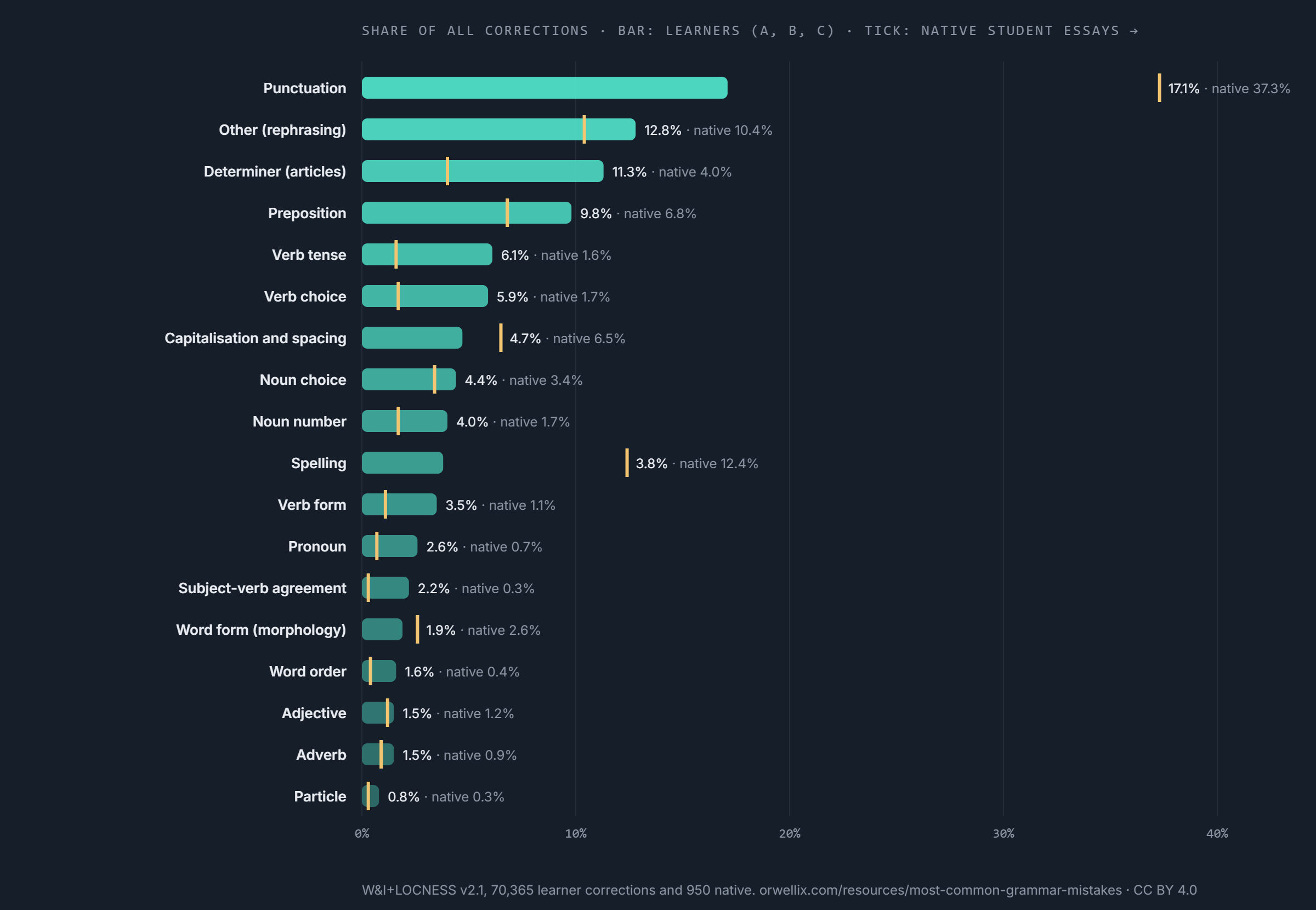
Bars are the share of all learner corrections; the amber tick is the share in native student essays. Where the tick sits far from the bar, the error belongs to one group.

Share of corrections by error type

70,365 learner corrections (A, B, C) and 950 native

Share of corrections by error type, learners versus native writersPunctuation: learners 17.1%, native 37.3%; Other (rephrasing): learners 12.8%, native 10.4%; Determiner (articles): learners 11.3%, native 4%; Preposition: learners 9.8%, native 6.8%; Verb tense: learners 6.1%, native 1.6%; Verb choice: learners 5.9%, native 1.7%; Capitalisation and spacing: learners 4.7%, native 6.5%; Noun choice: learners 4.4%, native 3.4%; Noun number: learners 4%, native 1.7%; Spelling: learners 3.8%, native 12.4%; Verb form: learners 3.5%, native 1.1%; Pronoun: learners 2.6%, native 0.7%; Subject-verb agreement: learners 2.2%, native 0.3%; Word form (morphology): learners 1.9%, native 2.6%; Word order: learners 1.6%, native 0.4%; Adjective: learners 1.5%, native 1.2%; Adverb: learners 1.5%, native 0.9%; Particle: learners 0.8%, native 0.3%SHARE OF ALL CORRECTIONS · BAR: LEARNERS (A, B, C) · TICK: NATIVE STUDENT ESSAYS →0%10%20%30%40%Punctuation17.1% · native 37.3%Other (rephrasing)12.8% · native 10.4%Determiner (articles)11.3% · native 4.0%Preposition9.8% · native 6.8%Verb tense6.1% · native 1.6%Verb choice5.9% · native 1.7%Capitalisation and spacing4.7% · native 6.5%Noun choice4.4% · native 3.4%Noun number4.0% · native 1.7%Spelling3.8% · native 12.4%Verb form3.5% · native 1.1%Pronoun2.6% · native 0.7%Subject-verb agreement2.2% · native 0.3%Word form (morphology)1.9% · native 2.6%Word order1.6% · native 0.4%Adjective1.5% · native 1.2%Adverb1.5% · native 0.9%Particle0.8% · native 0.3%W&I+LOCNESS v2.1, 70,365 learner corrections and 950 native. orwellix.com/resources/most-common-grammar-mistakes · CC BY 4.0
ERRANT error types on human corrections. 'Unknown' (errors marked but not corrected, about 2.5%) is omitted from the chart and kept in the table.
03
By level, with examples

Every error type at every level.

Share of corrections per level. Open a row for what the type covers, the insert / replace / delete split, the rate per 1,000 words, and short examples from the corpus with their corrections.

Grammar error types by proficiency level
Punctuation
PUNCT
117.1%14.7%17.8%22.3%37.3%17.4
Other (rephrasing)
OTHER
212.8%14.6%11.8%10.1%10.4%13.0
Determiner (articles)
DET
311.3%10.7%11.8%11.6%4.0%11.4
Preposition
PREP
49.8%8.7%10.5%11.4%6.8%10.0
Verb tense
VERB:TENSE
56.1%6.5%6.0%5.4%1.6%6.2
Verb choice
VERB
65.9%5.9%5.9%5.6%1.7%5.9
Capitalisation and spacing
ORTH
74.7%6.4%3.6%2.6%6.5%4.8
Noun choice
NOUN
84.4%3.9%4.7%4.8%3.4%4.4
Noun number
NOUN:NUM
94.0%4.1%4.2%3.4%1.7%4.1
Spelling
SPELL
103.8%4.2%3.6%3.1%12.4%3.8
Verb form
VERB:FORM
113.5%3.7%3.5%3.2%1.1%3.6
Pronoun
PRON
122.6%2.8%2.5%2.3%0.7%2.7
Unknown (detected, not corrected)
UNK
132.6%3.1%2.3%1.8%2.2%2.6
Subject-verb agreement
VERB:SVA
142.2%2.4%2.2%1.8%0.3%2.3
Word form (morphology)
MORPH
151.9%1.7%2.0%2.0%2.6%1.9
Word order
WO
161.6%1.3%1.8%2.0%0.4%1.6
Adjective
ADJ
171.5%1.3%1.7%1.8%1.2%1.5
Adverb
ADV
181.5%1.5%1.6%1.5%0.9%1.5
Particle
PART
190.8%0.8%0.8%1.2%0.3%0.9
Possessive
NOUN:POSS
200.6%0.5%0.6%1.0%2.4%0.6
Conjunction
CONJ
210.5%0.6%0.5%0.4%0.6%0.5
Contraction
CONTR
220.3%0.3%0.3%0.2%0.6%0.3
Comparative and superlative
ADJ:FORM
230.2%0.3%0.3%0.2%0.0%0.2
Noun inflection
NOUN:INFL
240.1%0.1%0.1%0.1%0.4%0.1
Verb inflection
VERB:INFL
250.0%0.1%0.0%0.0%0.3%0.0
Showing 25 of 25 rowsA, B and C are CEFR levels (beginner, intermediate, advanced) on the Write & Improve platform. The native column is 50 LOCNESS essays, a small sample: treat its percentages as indicative. Examples are excerpts under 100 words, as the corpus licence allows.
04
How often

The mix stays, the rate falls.

Corrections per 100 words and per sentence at each level, and the split between words inserted, replaced and deleted.

Correction rates by level
LevelTextsWordsCorrections / 100 wordsPer sentenceSentences correctedInsert / replace / delete
A (beginner)1,430202,37515.92.7979.5%23.0 / 63.6 / 10.4%
B (intermediate)1,100261,83710.31.8871.0%26.0 / 60.6 / 11.2%
C (advanced)770228,3644.90.9551.0%30.2 / 57.7 / 10.3%
Native (LOCNESS)5023,1174.10.9652.2%33.1 / 57.6 / 7.2%
Showing 4 of 4 rows

A level-A writer gets a correction every 6 words; a level-C writer every 20; a native student every 24. The native rate is not zero because the LOCNESS essays were corrected by the same annotators to the same standard, and because commas, spelling and apostrophes do not go away. The table above shows that the ranking of grammar errors is nearly identical at A, B and C: learners do not trade article errors for subtler ones as they improve, they make fewer of the same ones.

05
Other corpora

Three other learner corpora, same classifier.

The BEA-2019 task paper re-labelled three older corpora with ERRANT. Their top types, as published, next to ours. Differences reflect who wrote the texts and how freely annotators rewrote them.

Top error types in other learner corpora (percent of edits, as published)
CorpusEditsLargest typesSource
W&I+LOCNESS learners (this page)70,365Punctuation 17.1% · Other (rephrasing) 12.8% · Determiner (articles) 11.3% · Preposition 9.8% · Verb tense 6.1% · Verb choice 5.9% · Capitalisation and spacing 4.7%this page
FCE (Cambridge First Certificate exam scripts, 2000-01)52,671Preposition 11.2% · Determiner (articles) 10.9% · Other (rephrasing) 13.3% · Punctuation 9.7% · Spelling 9.6% · Verb choice 7.0% · Verb tense 6.0%[1]
NUCLE (NUS undergraduate essays)44,482Other (rephrasing) 25.6% · Determiner (articles) 16.0% · Noun number 8.1% · Preposition 7.7% · Verb tense 7.0% · Punctuation 5.2% · Verb choice 4.3%[1]
Lang-8 (online learner journal, automatic alignment)1,400,902Other (rephrasing) 26.6% · Determiner (articles) 11.9% · Preposition 8.0% · Verb choice 6.5% · Punctuation 6.1% · Verb tense 6.0% · Noun choice 4.5%[1]
Showing 4 of 4 rowsNUCLE's high share of 'other' and determiner errors reflects its Singapore undergraduate writers and its annotation guidelines; Lang-8's types were extracted automatically from uncorrected-corrected pairs, so its 'other' share is inflated.
06
By first language

Which errors depend on where you come from.

Our corpus records no first language. The FCE exam corpus does, and Berzak, Reichart and Katz tested whether each structural error's rate differs across 14 language backgrounds. Their 20 most frequent types, with the verdict.

Berzak et al. 2015: structural error types in FCE by first language
Error type (CLC code)Rate differs by first language
1Verb tense TV3,324yes (p < 0.01)
2Replace preposition RT3,311yes (p < 0.01)
3Missing determiner MD2,967yes (p < 0.01)
4Wrong verb form FV1,789yes (p < 0.01)
5Word order W1,534yes (p < 0.01)
6Missing preposition MT1,435yes (p < 0.01)
7Unnecessary determiner UD1,321no significant difference
8Unnecessary preposition UT1,079no significant difference
9Missing pronoun MA984yes (p < 0.01)
10Verb agreement AGV916yes (p < 0.01)
11Wrong form of noun FN884yes (p < 0.01)
12Replace pronoun RA847yes (p < 0.01)
13Noun agreement AGN816yes (p < 0.01)
14Replace determiner RD676yes (p < 0.01)
15Wrongly derived adjective DJ608yes (p < 0.01)
16Wrongly derived noun DN536no significant difference
17Wrongly derived adverb DY414yes (p < 0.01)
18Unnecessary pronoun UA391yes (p < 0.01)
19Missing conjunction MC346yes (p < 0.01)
20Replace conjunction RC226no significant difference
Showing 20 of 20 rowsSpelling, punctuation and word-choice types were excluded by the authors as not structural. 1,228 essays from speakers of Catalan, Chinese, French, German, Greek, Italian, Japanese, Korean, Polish, Portuguese, Russian, Spanish, Thai and Turkish.

Thirteen of the twenty types differ significantly by first language, with missing determiners the most language-dependent: speakers of languages without articles make the error far more often[9]. The same corpus's overall ranking, verb tense, prepositions and missing determiners at the top, matches ours. We hold the FCE data with its first-language field but have not published per-language counts from it, because the dataset's current licence asks for the publisher's approval before releasing derived statistics; the figures here are the authors' own.

07
Native writers

The native-speaker lists everybody cites.

Connors and Lunsford counted errors in 3,000 US college papers in 1988; Lunsford and Lunsford repeated the study on 877 papers in 2008. Their lists are the standard citation, and they are about native college writers marked by teachers, not learners.

1988, top ten (share of errors)

  1. Missing comma after introductory phrase 11.5%
  2. Vague pronoun reference 9.8%
  3. Missing comma in compound sentence 8.6%
  4. Wrong word 7.8%
  5. No comma in nonrestrictive relative clause 6.5%
  6. Wrong or missing inflected ending 5.9%
  7. Wrong or missing preposition 5.5%
  8. Comma splice 5.5%
  9. Possessive apostrophe error 5.1%
  10. Tense shift 5.1%

As reproduced in a teaching handout; the article itself could not be opened[13].

2008, rank order

  1. Wrong word
  2. Missing comma after an introductory element
  3. Incomplete or missing documentation
  4. Vague pronoun reference
  5. Spelling error (including homonyms)
  6. Mechanical error with a quotation
  7. Unnecessary comma
  8. Unnecessary or missing capitalization
  9. Missing word
  10. Faulty sentence structure
  11. Missing comma with a nonrestrictive element
  12. Unnecessary shift in verb tense
  13. Missing comma in a compound sentence
  14. Unnecessary or missing apostrophe
  15. Fused (run-on) sentence
  16. Comma splice
  17. Lack of pronoun-antecedent agreement
  18. Poorly integrated quotation
  19. Unnecessary or missing hyphen
  20. Sentence fragment

Rank order only; percentages are in the original article, which could not be opened[14].

Read beside our native sample, the lists agree on the shape: punctuation first, then word choice and spelling, with grammar in the strict sense well down. Between 1988 and 2008, "wrong word" rose from fourth to first and spelling fell to fifth, which the authors attributed to spell-checkers catching non-words and introducing wrong ones. Our native sample is 50 essays, so we report it as an indication, not a replication.

08
Method, limitations, data

How the mistakes were counted.

Method

The corpus is W&I+LOCNESS v2.1, released for the BEA-2019 shared task[1][2]: 3,300 texts submitted to Cambridge's Write & Improve platform by learners at CEFR levels A, B and C, and 50 native-speaker essays from LOCNESS[4], each corrected by annotators. We used the training and development sets, which carry gold corrections; the test set does not.

  • Every correction is labelled with one of 25 ERRANT error types plus an operation (missing, replacement, unnecessary)[5]. We counted the first annotator's edits, excluding 'no-op' lines, per level and in total; our totals reproduce the task paper's Table 4 exactly.
  • Rates per 100 words use the token counts in the corpus readme. Examples are sentences of 20 words or fewer with a short edit, chosen as the shortest per level.
  • Prior figures are quoted from the BEA-2019 paper, the CoNLL-2014 paper, Berzak et al. 2015 and the teaching reproductions of Connors and Lunsford.

Limitations

  • Error types are automatic labels on human corrections. ERRANT's raters judged 96% acceptable; 'other' absorbs what it cannot classify.
  • Levels are the platform's CEFR placements, and the learners are people who chose to use a writing-improvement tool, mostly writing short essays and letters.
  • The native sample is 50 essays and 950 corrections. Its percentages move by several points if a few essays change.
  • No first-language field exists in W&I+LOCNESS; the first-language findings are Berzak et al.'s on FCE, not ours.
  • The corpus is licensed for non-commercial research and educational use and is not redistributed here; the published counts and excerpts follow its terms, and the Write & Improve placement paper is cited as the licence requires[3].
09
Sources

15 documents, each one opened.

The corpus release and its licences, the classifier papers, the earlier corpus studies and the native-speaker reproductions.

  1. Bryant, C., Felice, M., Andersen, Ø. E., & Briscoe, T. (2019). The BEA-2019 Shared Task on Grammatical Error Correction. Proceedings of the 14th Workshop on Innovative Use of NLP for Building Educational Applications (ACL W19-4406). SourceOpened 23 Oct 2026
  2. University of Cambridge, Write & Improve (2019). W&I+LOCNESS v2.1 (BEA-2019 release): data, readme and licences. cl.cam.ac.uk; non-commercial research and educational use; excerpts under 100 words permitted. SourceOpened 23 Oct 2026
  3. Yannakoudakis, H., Andersen, Ø. E., Geranpayeh, A., Briscoe, T., & Nicholls, D. (2018). Developing an automated writing placement system for ESL learners. Applied Measurement in Education 31(3) (the citation the W&I licence requires). SourceOpened 23 Oct 2026
  4. Granger, S. (Centre for English Corpus Linguistics, UCLouvain) (2019). LOCNESS: Louvain Corpus of Native English Essays (BEA-2019 subset). credit required by the LOCNESS licence; 50 annotated native essays in the development set. SourceOpened 23 Oct 2026
  5. Bryant, C., Felice, M., & Briscoe, T. (2017). Automatic Annotation and Evaluation of Error Types for Grammatical Error Correction. ACL 2017 (P17-1074); the ERRANT framework and its 25 error types. SourceOpened 23 Oct 2026
  6. Bryant, C. (2019). Automatic annotation of error types for grammatical error correction. University of Cambridge Technical Report UCAM-CL-TR-938, Chapter 5 (error type definitions). SourceOpened 23 Oct 2026
  7. Ng, H. T., Wu, S. M., Briscoe, T., Hadiwinoto, C., Susanto, R. H., & Bryant, C. (2014). The CoNLL-2014 Shared Task on Grammatical Error Correction. CoNLL 2014 (W14-1701); NUCLE error types and distribution. SourceOpened 23 Oct 2026
  8. Yannakoudakis, H., Briscoe, T., & Medlock, B. (2011). A New Dataset and Method for Automatically Grading ESOL Texts. ACL-HLT 2011 (P11-1019); the public FCE dataset. SourceOpened 23 Oct 2026
  9. Berzak, Y., Reichart, R., & Katz, B. (2015). Contrastive Analysis with Predictive Power: Typology Driven Estimation of Grammatical Error Distributions in ESL. CoNLL 2015 (K15-1010); error frequency by first language on FCE. SourceOpened 23 Oct 2026
  10. Nicholls, D. (2003). The Cambridge Learner Corpus: error coding and analysis for lexicography and ELT. Proceedings of Corpus Linguistics 2003, pp. 572-581. SourceOpened 23 Oct 2026
  11. Bryant, C., Yuan, Z., Qorib, M. R., Cao, H., Ng, H. T., & Briscoe, T. (2023). Grammatical Error Correction: A Survey of the State of the Art. Computational Linguistics; arXiv:2211.05166 (corpus descriptions). SourceOpened 23 Oct 2026
  12. National University of Singapore (n.d.). NUS Non-commercial research/trial corpus license (NUCLE). comp.nus.edu.sg. SourceOpened 23 Oct 2026
  13. Doverspike, W. (reproducing Gocsik, K., Dartmouth) (n.d.). Top 20 grammar errors (Connors and Lunsford 1988, as reproduced in a teaching handout). secondary: the 1988 and 2008 CCC articles themselves could not be opened. SourceOpened 23 Oct 2026
  14. Excelsior Online Writing Lab (n.d.). 20 Most Common Grammar Errors (the Lunsford and Lunsford 2008 ranking). LibreTexts, CC BY 4.0; secondary. SourceOpened 23 Oct 2026
  15. Grammarly (2023). 30 Grammar Mistakes Writers Should Avoid. grammarly.com (vendor); no method or frequency figures. SourceOpened 23 Oct 2026
10
Cite and track

Cite this page.

Cite this page

APA

Orwellix. (2026). The Most Common English Grammar Mistakes, Measured. Orwellix. https://orwellix.com/resources/most-common-grammar-mistakes

Plain

The Most Common English Grammar Mistakes, Measured (Orwellix, 2026): https://orwellix.com/resources/most-common-grammar-mistakes

First published 25 Oct 2026. Reuse the tables and charts with attribution under CC BY 4.0.

Changelog

  1. First edition: 25 error types counted across 3,350 learner texts and 50 native essays (W&I+LOCNESS v2.1), by CEFR level, with examples, prior corpus distributions, the first-language findings and the native-speaker benchmarks.
11
Questions

The questions this page gets asked.

01What is the most common grammar mistake in English?

In 70,000 corrections to 3,350 learner texts, punctuation is the largest single category, 17% of all edits, and it grows with proficiency: 15% of a beginner's corrections, 22% of an advanced learner's, 37% of a native speaker's. Among grammar proper, articles and determiners lead at 11%, then prepositions at 10%, then verb tense at 6%. Native-speaker studies of US college writing put 'wrong word' and the missing comma after an introductory element at the top.

02Which mistakes do non-native speakers make most?

Articles, prepositions and verb tense, in that order, and the mix barely changes from beginner to advanced; what changes is the rate. Beginners receive 15.8 corrections per 100 words, intermediate learners 10.3, advanced learners 4.9 and native students 4.1. By first language, Berzak and colleagues found that 13 of the 20 most frequent structural errors occur at significantly different rates across 14 language backgrounds, with missing determiners differing most.

03Where do these numbers come from?

From the W&I+LOCNESS corpus released for the BEA-2019 shared task: 3,350 texts written on Cambridge's Write & Improve platform by learners at CEFR levels A, B and C, plus 50 native-speaker essays from LOCNESS, each corrected by annotators and every correction classified into one of 25 ERRANT error types. We counted the training and development sets, which carry gold annotations; the test set does not.

04Are the error types assigned by people or by software?

The corrections are human. The type labels were assigned automatically by ERRANT, a rule-based classifier whose authors report that five human raters judged 96% of its labels good or acceptable. 'Other' is the category for rewrites it cannot classify, which is why it sits near the top of every learner corpus.

05Why are the native-speaker figures so different?

Two reasons. The native sample is small, 50 essays and 950 corrections, so treat its percentages as indicative. And its writers do not make article or tense errors, so the corrections that remain are the ones everybody makes: commas, spelling and the occasional possessive. More than a third of corrections to native essays are punctuation.

06Can I reuse the table?

Yes, with a link to this page. The counts are ours; the underlying corpus is licensed for non-commercial research and educational use and is not redistributed here. Example sentences are excerpts of under 100 words, as the licence allows.

All resources · The Passive Voice Index · Writing Benchmarks by Genre