Original research · 124,832 sentences · 9 genres

Passive voice: 32% of sentences in encyclopedia (Wikipedia), 6% in SaaS marketing pages.

Writing advice repeats a number, usually "under 10%", that nobody measured. This index measures it: 3,353 public documents across 9 kinds of writing, every sentence scored by the same detector, with the detector's own accuracy measured on a blind sample. Use the rate for your genre, not a rule from a plugin.

  • Updated 24 Oct 2026
  • Verified 23 Oct 2026
  • Documents 3,353
  • Words 2,615,211
  • 22.1%of sentences carry a passive, mean across all documents
  • 13%of passives name an agent with "by"
  • 75%of documents exceed the 10% rule
  • 92%detector precision on a blind sample of 180 sentences
01
Key findings

Eight things the corpus says.

Each is a complete, citable sentence with its number. The intervals are bootstrap 95% intervals over documents.

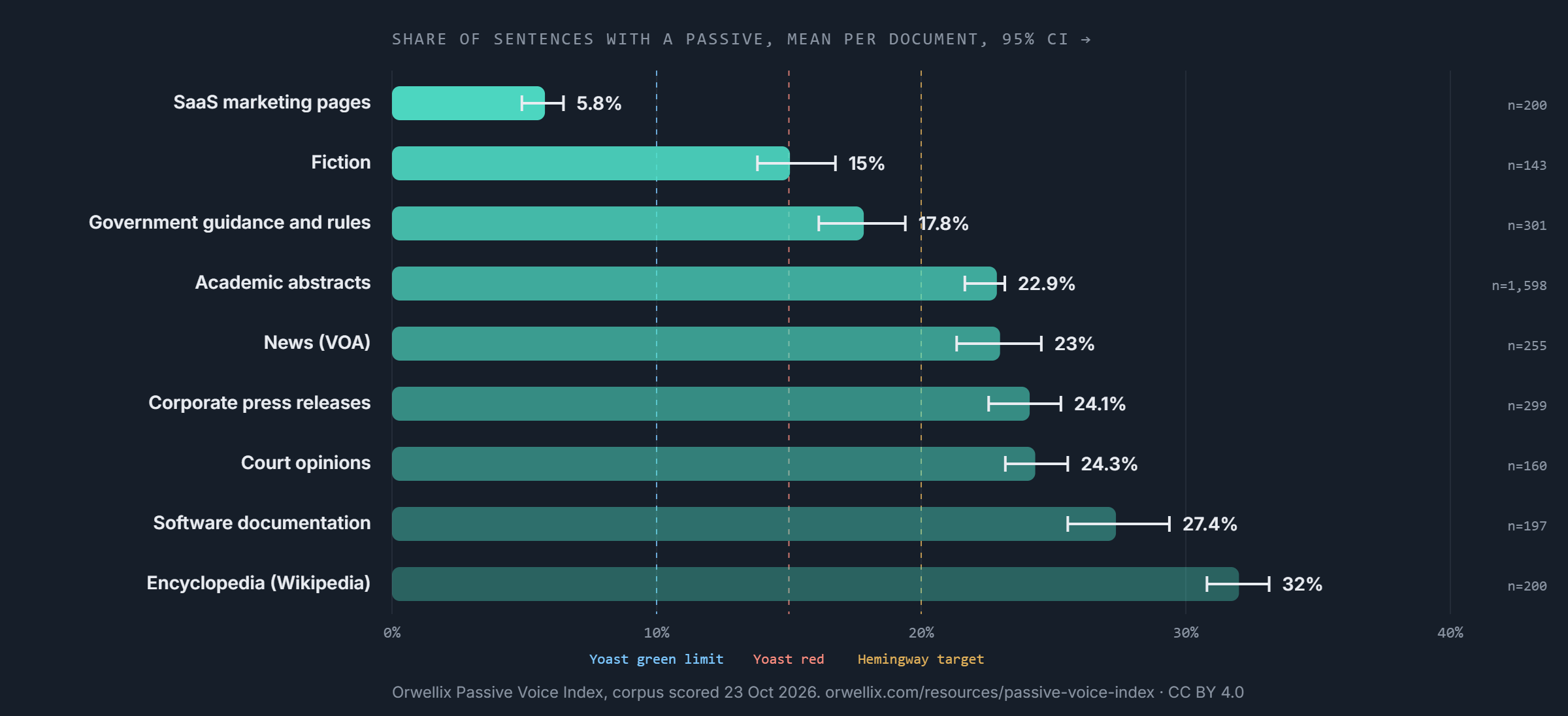
  1. Encyclopedia (Wikipedia) carries a passive in 32% of sentences on average; SaaS marketing pages in 5.8%. Every other genre sits between them.

    Document means with 95% bootstrap intervals: Encyclopedia (Wikipedia) 30.8% to 33.2%; SaaS marketing pages 4.9% to 6.5%.

  2. Academic abstracts are not one thing: medicine abstracts use a passive in 32.6% of sentences, computer science abstracts in 11.8%.

    11 fields, 1,598 abstracts in all. The spread between fields is wider than the spread between news and government prose.

  3. Fiction, the register writing advice most often holds up as a model, uses passives in 15% of sentences, about one in 7. News runs at 23%.

    Public-domain fiction, mostly written before 1930, so the comparison is with classic prose, not with today's bestsellers.

  4. The 10% limit that Yoast turns green at is below the median document in 8 of the 9 genres. 75% of the 3,353 documents exceed it, 61% exceed Yoast's 15% red line, and 48% exceed Hemingway's one-in-five target.

    Genres whose median document stays under 10%: SaaS marketing pages.

  5. Most passives name no agent. Across the whole corpus only 13% of passive clauses carry a by-phrase; the rest leave the actor out, which is usually the point.

    Biber's 1988 figure, as reported by Roland and colleagues, was about one by-passive to twelve agentless ones.

  6. Government writing uses passives in 17.8% of sentences across Federal Register rules and GOV.UK guidance, against 24.3% in court opinions and 24.1% in corporate press releases.

    Lower than both: the plain-language guidelines that call passives "one of the biggest problems with government writing" have had an audience.

  7. Per 100 verb phrases, the written genres here run from 2.4 to 13.3, bracketing the 9 to 11 that Roland, Dick and Elman found in the Brown corpus and the Wall Street Journal.

    Verb phrases are counted by the tagger, so this measure is approximate; it is here so the index can be set beside the corpus-linguistics literature.

  8. Get-passives are rare in edited prose: 0.7% of all passive clauses, and almost all of those in fiction and news.

    "Got arrested", "get caught": the informal passive that corpus studies find rising in speech barely appears in writing.

02
By genre

Where each kind of writing sits.

Mean share of sentences containing at least one passive clause, per document, with 95% intervals. The dashed lines are the limits that editing tools apply.

Passive voice by genre

9 genres, 3,353 documents, 124,832 sentences

Share of sentences with a passive clause by genreSaaS marketing pages 5.8%; Fiction 15%; Government guidance and rules 17.8%; Academic abstracts 22.9%; News (VOA) 23%; Corporate press releases 24.1%; Court opinions 24.3%; Software documentation 27.4%; Encyclopedia (Wikipedia) 32%SHARE OF SENTENCES WITH A PASSIVE, MEAN PER DOCUMENT, 95% CI →0%10%20%30%40%Yoast green limitYoast redHemingway targetSaaS marketing pages5.8%n=200Fiction15%n=143Government guidance and rules17.8%n=301Academic abstracts22.9%n=1,598News (VOA)23%n=255Corporate press releases24.1%n=299Court opinions24.3%n=160Software documentation27.4%n=197Encyclopedia (Wikipedia)32%n=200Orwellix Passive Voice Index, corpus scored 23 Oct 2026. orwellix.com/resources/passive-voice-index · CC BY 4.0
Bars are document means; whiskers are bootstrap 95% intervals (2,000 resamples). A sentence counts as passive if it contains at least one be- or get-passive clause, finite or not, excluding adjectival states.
03
Academic fields

Which fields write in the passive.

Abstracts only, 1,598 of them, from arXiv, PubMed and OpenAlex. Abstracts are where authors describe what was done, so rates run higher than in full papers' discussion sections.

Passive voice in academic abstracts, by field

11 fields, 2023 to 2026

Share of sentences with a passive clause in academic abstracts, by fieldComputer science 11.8%; Mathematics 13%; Economics 16.5%; Biology 17.1%; Statistics 18.5%; Humanities 21.6%; Physics 21.7%; Social sciences 24.4%; Psychology 29.6%; Public health 30.7%; Medicine 32.6%SHARE OF SENTENCES WITH A PASSIVE, MEAN PER DOCUMENT, 95% CI →0%10%20%30%40%Computer science11.8%n=85Mathematics13%n=86Economics16.5%n=113Biology17.1%n=245Statistics18.5%n=117Humanities21.6%n=120Physics21.7%n=118Social sciences24.4%n=134Psychology29.6%n=284Public health30.7%n=148Medicine32.6%n=148Orwellix Passive Voice Index, corpus scored 23 Oct 2026. orwellix.com/resources/passive-voice-index · CC BY 4.0
Same measure as above. Fields with experimental methods sections (medicine, biology, chemistry-adjacent physics) sit high; mathematics and economics, which argue rather than report procedures, sit low.

Earlier corpus work found the same split. Seoane and Hundt report that hard sciences default to the passive for transitive events while soft sciences often prefer the active[8], and Riley found passives clustering in Method and Results sections and thinning out in the Introduction and Discussion[6]. Banks measured passives at about 30% of finite verbs in physical-science papers in 1985 and 24% in biology, with the share of actives rising in multi-author papers by 2015[4]. The abstracts here are consistent with that long decline: high, but not the two-thirds of passivizable verbs that scientific prose carried in the 1960s.

04
All subgenres

Every subgenre, every measure.

Sort by any column. Open a row for the source and the sampling rule. Pooled rates weight by sentence; means weight by document.

Passive-voice rates by subgenre
MDN Web DocsSoftware documentation602,98936.736.835.11420.68%
Node.js docsSoftware documentation424,80732.934.133.720.837.36%
MedicineAcademic abstracts1481,90932.632.332.714.515.85%
New York (N.Y.3d)Court opinions291,95632.433.332.491212%
Wikipedia featured articlesEncyclopedia (Wikipedia)20020,1433231.631.71315.719%
Public healthAcademic abstracts1481,43630.728.631.412.915.18%
PsychologyAcademic abstracts2842,93829.627.529.812.2156%
Kubernetes docsSoftware documentation472,74025.424.725.114.322.88%
Social sciencesAcademic abstracts1341,19024.422.224.510.511.810%
Press releases (8-K exhibits)Corporate press releases2997,10324.123.123.58.69.913%
California (Cal. 4th)Court opinions918,98323.521.722.77.39.613%
GOV.UK guidanceGovernment guidance and rules1507,37523.220.624.39.114.98%
VOA newsNews (VOA)2534,44623.12022.76.99.517%
US Supreme CourtCourt opinions141,41222.621.3228.510.316%
PhysicsAcademic abstracts11898421.718.2218.1914%
HumanitiesAcademic abstracts1201,43321.62019.29.49.710%
Federal appellate (F.3d)Court opinions262,83019.117.818.979.214%
StatisticsAcademic abstracts11794518.516.718.56.68.88%
BiologyAcademic abstracts2452,10317.114.317.66.17.912%
EconomicsAcademic abstracts11393316.514.3165.58.218%
Public-domain fictionFiction14312,2591512.51346.413%
Federal Register: NoticesGovernment guidance and rules662314.513.215.113.714.26%
React docsSoftware documentation433,33413.711.81358.67%
MathematicsAcademic abstracts865991311.112.95.76.421%
Federal Register: Final rulesGovernment guidance and rules588,01012.911.212.21011.811%
Federal Register: Proposed rulesGovernment guidance and rules8711,09012.112.511.610.511.59%
Computer scienceAcademic abstracts8573411.811.111.245.312%
SaaS homepagesSaaS marketing pages2009,2485.84.75.82.43.78%
The Rust Programming LanguageSoftware documentation52255.44.95.32.858%
VOA USANews (VOA)2555.35.35.51.31.80%
Showing 30 of 30 rowsVPs = verb phrases as counted by the tagger, an approximation.
05
The 10% rule

Where the rules came from, and how the corpus scores against them.

Editing tools turn a light red at a share of passive sentences. Here is what each one says, what it rests on, and how often real writing crosses the line.

Passive-voice rules in tools and style guides
Tool or guideRuleWhat it rests on
Yoast SEOGreen under 10% of sentences, red over 15%"Based on testing"; no study cited[13]
Hemingway EditorTarget of one passive per five sentences (20%)Read from the app's shipped code, not documented[14]
GrammarlyNo threshold; "better to avoid ... in most writing"Editorial guidance[15]
APA Publication Manual, 7th ed.Active "as much as possible"; passive for experimental set-upBoth voices permitted[9]
US federal plain language (digital.gov)Use active voice; passive "one of the biggest problems with government writing"Exceptions allowed; no limit[10]
SEC Plain English Handbook"Don't ban the passive voice, use it sparingly"Style-checker flags are "suggestions"[12]
GOV.UK style guide"Use the active voice rather than the passive voice"No limit[11]
Nature, IEEENo guidance on voice at allChecked in their author instructions[21]
Showing 8 of 8 rows

How real writing scores against them

Across all 3,353 documents, 75% would fail Yoast's green threshold, 61% would show red, and 48% would miss Hemingway's target. By genre: fiction 66% over 10%, news 80%, government 73%, press releases 80%, court opinions 97%, academic abstracts 74%, encyclopedia 100%, marketing pages 17%. The thresholds were set for blog posts; a plugin that reddens a court opinion or a methods section is reporting the genre, not a fault.

None of the style guides sets a number. APA permits both voices and asks for the active "as much as possible"[9]; the US federal guidelines call the passive a leading problem but allow it where the law itself is the actor[10]; the SEC says "don't ban the passive voice, use it sparingly" and calls checker output "suggestions"[12]; Nature and IEEE say nothing about voice at all[21][22].

06
Earlier studies

What corpus linguists measured before.

The literature used different denominators, so the numbers are not directly comparable, but the ordering is the same: speech lowest, fiction and news low, academic prose highest, and a decline since the 1960s.

Passive-voice rates in earlier corpus studies
StudyCorpusMeasureValueNote
Roland, Dick and Elman (2007)[1]Brown corpus, written American English, 1961Passives as % of verb phrases11%7.7 to 10.5 per 1,000 words in written corpora; 2% to 3% of verb phrases in conversation
Roland, Dick and Elman (2007)[1]British National Corpus, spokenPassives as % of verb phrases3%Written text is four to five times more likely to use a passive than speech
Banks (2017)[4]Royal Society journal articles, physical sciences, 1985Passives as % of finite verbs30%24% in biological sciences the same year; 31% in both series by 2015
Banks (2017), quoting Seoane and Loureiro-Porto (2005)[4]Scientific prose, 1985–1990Passives as % of passivizable verbs47% to 59%Down from 62% to 66% in 1960–1975
Mair and Leech (2006)[2]Brown versus Frown, 1961 versus 1992Be-passives per million words11,650 → 9,329A 20% fall in American written English; 12% in British (LOB versus F-LOB)
Leech (2004)[3]LOB versus FLOB by subcorpusChange in passive forms, 1961 to 1991−12.4%Press −12.5%, general prose −12.4%, learned −16.6%, fiction −3.6%
Biber (1988), as reported by Roland et al.[1]Mixed registersAgentless and by-passives per 1,000 words9.6 and 0.8Agentless passives outnumber by-passives roughly twelve to one
Showing 7 of 7 rows

The comprehension research behind the advice is thinner than the advice. Ferreira found that listeners misinterpret passives more often than actives, especially implausible ones[16]; Bader and Meng, repeating the work with a different task, found no passive-specific errors[17]. Pullum's survey of the writing-advice tradition argues that the stylistic case against the passive is largely baseless and that its critics routinely misidentify it[18]. The corpus adds the measurement the argument lacked: skilled, edited prose in every genre uses the passive at rates the tools would flag.

07
Method, accuracy, data

How it was measured, and how well.

Corpus and detector

3,353 documents, 124,832 sentences, 2,615,211 words, collected on 23 Oct 2026 from public or openly licensed sources only (sources 23 to 34). Long documents are capped at 2,000 to 3,000 words so one court opinion does not outweigh a hundred abstracts.

  • Sentences split and tagged with the compromise library[35]; headings, bullets and code dropped; sentences under three words dropped.
  • A passive is a form of be or get, then up to two adverbs or negations, then a past participle. Finite and non-finite forms both count; "to be", "being", "been" chains are counted once.
  • Excluded: adjectival states (interested, involved, tired, prepared, located as a state, un-prefixed adjectives), "used to" and "supposed to", participles used before nouns ("updated estimates").
  • A by-phrase within five tokens that is not a stock adverbial ("by then", "by law") marks an agent.
Accuracy

The detector was tuned on 343 hand-labelled sentences, then frozen. A second sample of 180 sentences, half flagged and half not, 20 per genre, was labelled blind afterwards.

  • Precision 92.2% (95% interval 85% to 96%): 7 of 90 flagged sentences had no passive, mostly idioms such as "get rid of", "is stuck on", "was headed to".
  • Miss rate 2.2% of unflagged sentences (2 of 90), which at the corpus-wide flag rate implies recall of about 92%.
  • Errors are not spread evenly: idiomatic get- and be-phrases cost precision in fiction and marketing; inverted passives ("also planned were") cost recall in encyclopedia prose. Genre rates may be biased by a point or two in those directions.
  • For comparison, published detectors report 97% to 98% agreement with human coding[19][20].

Limitations

  • Each genre is one or a few sources: VOA for news, Wikipedia for encyclopedia, SEC exhibits for corporate prose, Y Combinator companies for marketing. They are large and public, not representative of everything the label could mean.
  • Fiction is public-domain and therefore mostly pre-1930; its rate is a classic-prose benchmark, not a measure of current fiction.
  • Abstracts stand in for academic writing; full papers run lower outside the Methods and Results sections.
  • Scanned court opinions carry OCR noise, which inflates sentence counts slightly and lowers the legal rate by a fraction of a point.
  • The verb-phrase denominator comes from an automatic tagger and should be read as approximate; the sentence-based rate is the primary measure.
08
Sources

35 sources: studies, guides and corpora.

Literature first, then the tools and guides, then the corpora the index was built from.

  1. Roland, D., Dick, F., & Elman, J. L. (2007). Frequency of basic English grammatical structures: a corpus analysis. Journal of Memory and Language, 57(3), 348–379. doi:10.1016/j.jml.2007.03.002 (full text, PMC2722756). SourceOpened 23 Oct 2026
  2. Mair, C., & Leech, G. (2006). Current changes in English syntax. In The Handbook of English Linguistics (Blackwell), 318–342. Author typescript hosted by Lancaster University. SourceOpened 23 Oct 2026
  3. Leech, G. (2004). Recent grammatical change in English: data, description, theory. Author typescript hosted by Lancaster University (LOB versus FLOB, tokens per million words). SourceOpened 23 Oct 2026
  4. Banks, D. (2017). The extent to which the passive voice is used in the scientific journal article, 1985–2015. Functional Linguistics, 4, 12. doi:10.1186/s40554-017-0045-5 (open access, full text). SourceOpened 23 Oct 2026
  5. Leong, A. P. (2020). The passive voice in scientific writing through the ages: a diachronic study. Text & Talk, 40(4), 467–489. doi:10.1515/text-2020-2066 (abstract). SourceOpened 23 Oct 2026
  6. Riley, K. (1991). Passive voice and rhetorical role in scientific writing. Journal of Technical Writing and Communication, 21(3), 239–257. doi:10.2190/Y51Y-P6QF-3LCC-4AUH (abstract). SourceOpened 23 Oct 2026
  7. Hundt, M., Schneider, G., & Seoane, E. (2016). The use of the be-passive in academic Englishes: local versus global usage in an international language. Corpora, 11(1), 29–61. doi:10.3366/cor.2016.0084 (abstract). SourceOpened 23 Oct 2026
  8. Seoane, E., & Hundt, M. (2018). Voice alternation and authorial presence: variation across disciplinary areas in academic English. Journal of English Linguistics, 46(1), 3–22. doi:10.1177/0075424217740938 (abstract). SourceOpened 23 Oct 2026
  9. American Psychological Association (2026). Active and passive voice. APA Style, summarising Publication Manual 7th ed. §4.13; page updated April 2026. SourceOpened 23 Oct 2026
  10. Digital.gov (General Services Administration) (2026). Plain language guide: writing for understanding. Current home of the federal plain language guidelines. SourceOpened 23 Oct 2026
  11. Government Digital Service (2026). A to Z style guide: active voice. Writing to GOV.UK standards. SourceOpened 23 Oct 2026
  12. US Securities and Exchange Commission (1998). A Plain English Handbook. Office of Investor Education and Assistance, August 1998. SourceOpened 23 Oct 2026
  13. Yoast (2026). Passive voice assessment: features, help and false positives. Yoast SEO readability analysis pages and the 2019 blog post "The passive voice: what is it and how to avoid it?". SourceOpened 23 Oct 2026
  14. Hemingway Editor (Boondoggle Studio) (2026). Hemingway Editor web app. Passive-voice target read from the application's shipped JavaScript: round(sentences ÷ 5); not documented in its help centre. SourceOpened 23 Oct 2026
  15. Grammarly (2024). Passive voice: when to use it and when to avoid it. Grammarly blog, updated 19 December 2024. SourceOpened 23 Oct 2026
  16. Ferreira, F. (2003). The misinterpretation of noncanonical sentences. Cognitive Psychology, 47(2), 164–203. doi:10.1016/S0010-0285(03)00005-7 (abstract). SourceOpened 23 Oct 2026
  17. Bader, M., & Meng, M. (2018). The misinterpretation of noncanonical sentences revisited. Journal of Experimental Psychology: Learning, Memory, and Cognition, 44(8), 1286–1311. doi:10.1037/xlm0000519 (abstract). SourceOpened 23 Oct 2026
  18. Pullum, G. K. (2014). Fear and loathing of the English passive. Language & Communication, 37, 60–74. doi:10.1016/j.langcom.2013.08.009 (record and abstract; full text could not be opened). SourceOpened 23 Oct 2026
  19. Sepehri, A., Mirshafiee, M. S., & Markowitz, D. M. (2023). PassivePy: a tool to automatically identify passive voice in big text data. Journal of Consumer Psychology, 33(4), 714–727. doi:10.1002/jcpy.1377 (abstract and GitHub README). SourceOpened 23 Oct 2026
  20. Leong, C. S.-Y., & Linzen, T. (2024). Manipulating language models' training data to study syntactic constraint learning: the case of English passivization. arXiv:2407.04593 (full text). SourceOpened 23 Oct 2026
  21. Nature (2026). Formatting guide for authors. Contains no guidance on voice. SourceOpened 23 Oct 2026
  22. IEEE Publishing Operations (2024). IEEE editorial style manual for authors. Updated 29 July 2024; contains no guidance on voice. SourceOpened 23 Oct 2026
  23. arXiv (2026). arXiv API (export.arxiv.org). Abstracts by category; metadata CC0; one request per three seconds. SourceOpened 23 Oct 2026
  24. National Library of Medicine (2026). PubMed E-utilities. Abstracts by MeSH field; analysis only, not republished. SourceOpened 23 Oct 2026
  25. OpenAlex (2026). OpenAlex works API. Social-science, humanities and psychology abstracts; metadata CC0. SourceOpened 23 Oct 2026
  26. Project Gutenberg (2026). Project Gutenberg plain-text books via the Gutendex catalogue. Public-domain fiction (US); 2,000-word window from the middle of each book. SourceOpened 23 Oct 2026
  27. Wikipedia (2026). MediaWiki API: featured articles, plain-text extracts. CC BY-SA 4.0; first 2,500 words of each article. SourceOpened 23 Oct 2026
  28. Office of the Federal Register (2026). Federal Register API. Rules, proposed rules and notices published in 2025; public domain. SourceOpened 23 Oct 2026
  29. GOV.UK (2026). GOV.UK Content API and Search API. Guidance pages; Open Government Licence v3.0. SourceOpened 23 Oct 2026
  30. Caselaw Access Project, Harvard Law School Library (2026). static.case.law bulk data. Majority opinions, US Reports, F.3d, N.Y.3d and Cal. 4th, 1990 to 2019; restrictions lifted March 2024. SourceOpened 23 Oct 2026
  31. US Securities and Exchange Commission (2026). EDGAR full-text search and archives. Press releases filed as EX-99.1 exhibits to Form 8-K, November 2025 to October 2026; one per company. SourceOpened 23 Oct 2026
  32. Voice of America (2026). VOA terms of use and sitemaps. Text produced by VOA is public domain; wire-service items excluded by byline and dateline. SourceOpened 23 Oct 2026
  33. yc-oss (2026). Y Combinator companies JSON (community mirror). Seed list of active B2B software companies; homepages fetched once, robots.txt and noai signals honoured. SourceOpened 23 Oct 2026
  34. MDN Web Docs, React, Kubernetes, Rust book, Node.js (2026). Documentation source repositories on GitHub. CC BY-SA 2.5, CC BY 4.0, CC BY 4.0, MIT/Apache-2.0, MIT. SourceOpened 23 Oct 2026
  35. Kelly, S. (compromise contributors) (2026). compromise: modest natural language processing (JavaScript). Sentence splitting and part-of-speech tags used by the detector; MIT licence. SourceOpened 23 Oct 2026
09
Cite and track

Cite this study.

Cite this page

APA

Orwellix. (2026). The Passive Voice Index: passive-voice rates across 9 genres of English prose. Orwellix. https://orwellix.com/resources/passive-voice-index

Plain

The Passive Voice Index: passive-voice rates across 9 genres of English prose (Orwellix, 2026): https://orwellix.com/resources/passive-voice-index

First published 24 Oct 2026. Reuse the tables and charts with attribution under CC BY 4.0.

Changelog

  1. First edition: nine genres, 30 subgenres, 3,353 documents (124,832 sentences) scored with detector version 4; blind validation on 180 sentences.
10
Questions

What people ask about the passive.

01How much passive voice is normal?

It depends on what you are writing. In this corpus, between one in eight and one in three sentences carries a passive depending on the genre: fiction and marketing copy sit at the low end, encyclopedia and academic prose at the high end. The 10% rule that editing tools apply is below the median of every genre in this study except marketing pages.

02What counts as a passive here?

A clause whose verb is a form of be or get followed by a past participle, with up to two adverbs or negations between them: "was written", "has been shown", "will be reviewed", "to be considered", "got fired". Participles used as states or adjectives, such as "was tired", "is interested in" or "are involved in", are not counted. Sentences are counted as passive if they contain at least one such clause.

03Why report sentences rather than verbs?

Because that is what writing tools report and what writers can act on. The per-1,000-words and per-100-verb-phrases rates are in the tables too, so the figures can be set beside Roland, Dick and Elman's corpus counts.

04How accurate is the detector?

On a blind sample of 180 sentences labelled by hand after the detector was frozen, precision was 92% (95% interval 85% to 96%) and 2.2% of the sentences the detector cleared contained a passive it missed, which implies recall of about 92%. The detector was first tuned on a separate 343-sentence sample. Both samples are in the data files.

05Is the passive voice wrong?

No. Every style guide in the table permits it, and the one journal and one engineering style manual checked say nothing about it. The research on comprehension is mixed: passives are misread more often in laboratory sentences, especially implausible ones, but a later study found no misinterpretation once the task changed. The practical reading is that passives cost attention when the agent matters and cost nothing when it does not.

06Can I reuse these numbers?

Yes, with a link to this page. The aggregate tables and the per-document results are CC BY 4.0. The underlying texts stay with their owners and are not republished.

All resources · What is a good readability score? · Readability statistics 2026