"The web is full of AI writing" is a feeling. This is a count. The 127 words, phrases and sentence frames that published studies associate with model output[1][2][3] were counted per 10,000 words of prose on 1,530 public pages from seven kinds of site, and on the Wayback Machine's 2021 and 2019 captures of the same pages. It measures how often the vocabulary appears, not who wrote it: people wrote every one of these words before any model did.
+26%change in signature terms on the same pages, 2021 to 2026
14.0signature terms per 10,000 words, all 2026 pages
30%of 2026 pages contain at least one signature term
15.9 → 22.9em dashes per 10,000 words (Pangram: human 2, AI 17)
01
Key findings
Whatthecountsays.
Each finding is a complete, citable sentence with its number. Rates are hits per 10,000 words of extracted prose, pooled over the pages of a group; intervals are bootstrap 95% intervals over pages.
On 555 pages captured in 2021 and crawled again in 2026, AI-associated vocabulary rose: 13.8 signature terms per 10,000 words in 2021, 17.4 in 2026, a change of +26% (95% interval of the difference +0.8 to +6.4 per 10,000 words).
28% of the pages have a higher rate in 2026 than in 2021, 23% a lower one, the rest are unchanged. Pages with at least one signature term: 31% in 2021, 36% in 2026.
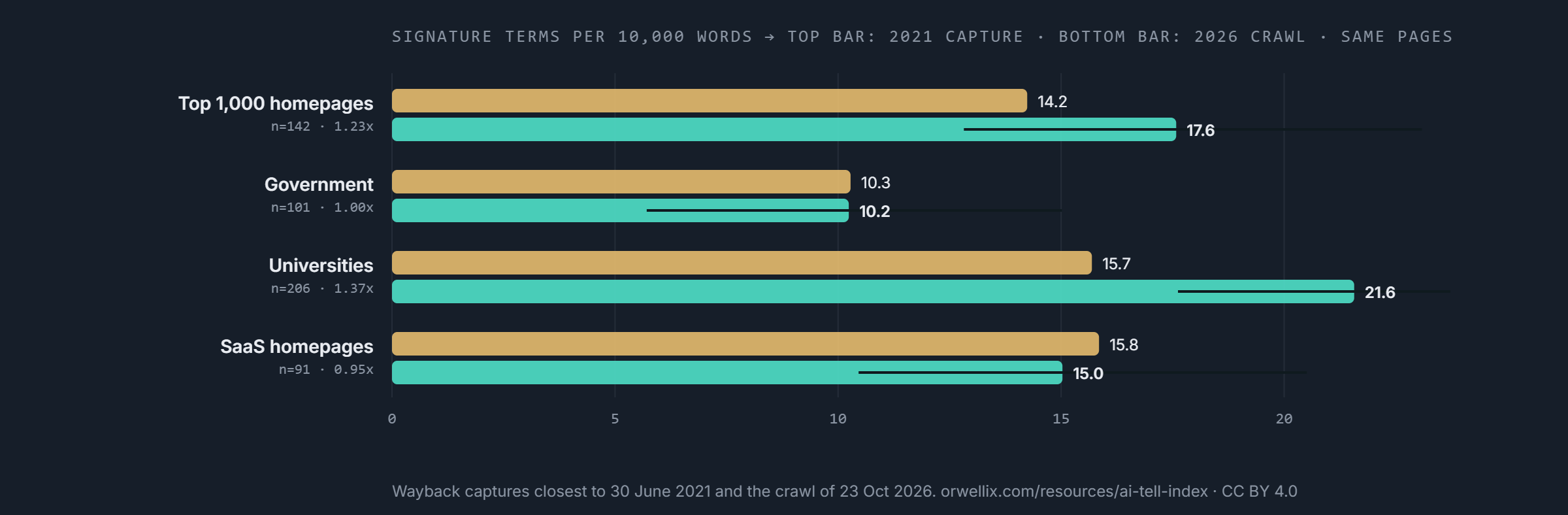
The change is not even. universities moved most, 1.37x (15.7 to 21.6 per 10,000 words on 206 pages); SaaS homepages least, 0.95x.
Universities 1.37x (n=206) · Top 1,000 homepages 1.23x (n=142) · Government 1.00x (n=101) · SaaS homepages 0.95x (n=91)
On the 370 pages with captures in 2019, 2021 and 2026, the rate went from 13.9 to 14.0 to 17.3 per 10,000 words: little movement in the two years before ChatGPT, most of the change after it.
The terms that rose most on the same pages: crucial (4.83x), play a [pivotal] role in [shaping] (2.90x), play a [crucial] role in (2.90x), strategic (2.47x), showcase (2.44x).
Terms that fell: hello [X] (0.15x), navigate (0.62x), unparalleled (0.72x), comprehensive (0.77x). A word a slice always used cancels out in the panel; only the change shows.
Em dashes on the same pages: 15.9 per 10,000 words in 2021, 22.9 in 2026. Pangram's benchmarks are 2 for human and 17 for AI documents[3].
Triads 51.6 to 66.3; "not just X but Y" 1.4 to 2.0; list items 422.9 to 301.9 per 10,000 words (Pangram: triads 5 vs 19, not-just-but 1 vs 3, list items 3 vs 28).
In 2026, universities use the most AI-associated vocabulary, 21.8 signature terms per 10,000 words, and news the least, 6.0. Across all 1,530 pages the rate is 14.0, and 30% of pages contain at least one signature term.
This ranking mixes two things: words models overuse and words a kind of site always used. The term table shows which drive each slice, and the panel removes the second.
The most frequent signature terms on the 2026 web are ordinary marketing words: empower (127), comprehensive (96), seamless (96), innovative (89), dynamic (87), strategic (65), significant (62), seamlessly (54). "Delve", the word every study names first, appears 6 times as "delve into" in 638,555 words of public-page prose.
Models learned their vocabulary from the web, so the web's own favourites top the list. The signature of model output is the rate, not the presence.
For scale, the reference corpora: research abstracts from 2023 to 2026 run at 27.3 signature terms per 10,000 words, US court opinions from 1991 to 2019 at 3.2, and public-domain books from before 1931 at 1.2. Corporate press releases filed in 2025 and 2026, a genre an earlier study estimated at up to 24% LLM-assisted[7], run at 14.2.
Reference corpora are not web pages and were extracted differently; they are context, not a baseline for the slices.
02
Same pages, 2021 vs 2026
ThesameURLs,before and afterChatGPT.
Every page crawled in October 2026 was looked up in the Wayback Machine for its capture closest to 30 June 2021, eighteen months before ChatGPT. Both versions went through the same extractor and the same dictionary. Whatever a kind of site always said cancels out; what is left is the change.
Signature terms per 10,000 words on the same pages, 2021 and 2026
5 slices, 555 pages with a usable 2021 capture
Amber: the 2021 capture. Teal: the 2026 crawl, with its 95% bootstrap interval. The ratio beside each slice is 2026 over 2021. Slices with fewer than 20 matched pages (news) are in the table below but not the chart. Help centers and pricing pages were not looked up: their platforms and URLs rarely existed in 2021.
Top 1,000 homepages Tranco list 56Z8N, ranks 1 to 1,000
142
14.2
17.6
1.23x
26.8
17.9 → 26.4
680.4 → 472.0
Government GSA Site Scanning live federal sites, 600 sampled
101
10.3
10.2
1.00x
13.9
4.4 → 10.9
256.6 → 247.4
SaaS homepages Y Combinator B2B companies, 600 sampled
91
15.8
15.0
0.95x
29.7
14.3 → 24.0
202.0 → 278.6
Showing 5 of 5 rowsSignature terms per 10,000 words. Open a row for the broad measure, categories, structure, markup, readability, the 2019 captures and the archive coverage.
03
By kind of site
Seven kindsofpagein2026.
The 2026 crawl alone. The bar is the 77 signature terms, the blue tick is all 127. This ranking mixes model habit with genre habit, which the panel above separates; the detail rows show which terms drive each slice.
AI-associated vocabulary by kind of site, 2026
7 slices, 1,530 pages, crawled 23 Oct 2026
Pages with fewer than 80 words of sentence-shaped prose are excluded, as in the State of Web Readability. Help centers are the subset of SaaS companies with a help subdomain.
Top 1,000 homepages Tranco list 56Z8N, ranks 1 to 1,000
258
18.3
27.6
36.4
27.1
538.2
10.6
Government GSA Site Scanning live federal sites, 600 sampled
203
15.3
21.4
24.1
12.9
242.5
13.3
Help centers help. or support. subdomains of the same companies
65
12.1
16.1
23.1
20.0
321.9
9.3
SaaS homepages Y Combinator B2B companies, 600 sampled
439
9.8
14.4
24.6
31.8
332.2
9.1
SaaS pricing same companies, /pricing
190
7.3
11.2
18.4
28.6
515.2
8.3
News 70 widely read English-language news sites
27
6.0
8.3
18.5
19.6
1354.8
9.3
Showing 7 of 7 rowsSignature: the 77 terms at least one measured study names. All terms: the 127 severity-3 entries of the AI Tell List.
Pages by signature-term rate, 2026
1,530 pages
Most pages carry a few signature terms per 10,000 words; a small tail carries many. The tail, not the median, is where the model-sounding pages live.
04
The terms
Whichwordsmoved,andwhichwerealwaysthere.
Every term in the dictionary, with its 2026 rate, the share of pages it appears on, and its rate on the same pages in 2021 and 2026. Filter to the signature set or a category; open a row for the rate by slice.
Terms that rose most on the same pages, 2021 to 2026
15 terms with at least 5 hits in 2026 on the panel pages
A half-count is added to both years before dividing, so a term with 0 hits in 2021 and 12 in 2026 shows as about 25x rather than infinity. Small counts move easily; read the hits beside each bar.
All terms
Named by
empower Inflated verbs · signature
1.99
7.1
2.73
3.42
1.25x
Kobak 2025
comprehensive Inflated adjectives and adverbs · signature
1.50
5.3
2.01
1.54
0.77x
Kobak 2025; GPTZero 2026
seamless Inflated adjectives and adverbs · signature
1.50
4.5
0.72
1.32
1.79x
Kobak 2025; Grammarly 2026
innovative Inflated adjectives and adverbs · signature
1.39
5.0
1.49
1.71
1.14x
Kobak 2025; Grammarly 2026
dynamic Inflated adjectives and adverbs
1.36
4.2
1.24
1.58
1.27x
Orwellix editorial
strategic Inflated adjectives and adverbs
1.02
3.5
0.46
1.19
2.47x
Orwellix editorial
significant Inflated adjectives and adverbs · signature
0.97
3.4
1.24
1.32
1.06x
GPTZero 2026
seamlessly Inflated adjectives and adverbs
0.85
3.2
0.77
0.92
1.18x
Grammarly 2026; Orwellix editorial
cutting-edge Inflated adjectives and adverbs
0.78
2.6
0.62
0.70
1.12x
Grammarly 2026
harness Inflated verbs · signature
0.74
1.8
0.21
0.35
1.61x
Grammarly 2026; Kobak 2025
robust Inflated adjectives and adverbs
0.69
2.6
0.57
0.61
1.07x
Orwellix editorial
showcase Inflated verbs · signature
0.63
2.1
0.36
0.92
2.44x
Kobak 2025
elevate Inflated verbs · signature
0.50
1.8
0.36
0.75
1.99x
Pangram 2026; Kobak 2025
holistic Inflated adjectives and adverbs
0.45
1.8
0.57
0.61
1.07x
Orwellix editorial
transformative Inflated adjectives and adverbs · signature
0.44
1.8
0.41
0.75
1.75x
GPTZero 2026; Kobak 2025; Grammarly 2026
crucial Inflated adjectives and adverbs · signature
0.42
1.4
0.05
0.35
4.83x
Kobak 2025; GPTZero 2026; Pangram 2026
revolutionize Inflated verbs · signature
0.41
1.2
0.05
0.26
–
Grammarly 2026; Kobak 2025
the importance of Stock nouns and metaphors · signature
0.36
1.2
0.57
0.61
1.07x
GPTZero 2026
unlock Inflated verbs · signature
0.31
1.1
0.31
0.57
1.77x
Kobak 2025; Orwellix editorial
impactful Inflated adjectives and adverbs
0.31
1.1
0.15
0.26
1.58x
Orwellix editorial
unparalleled Inflated adjectives and adverbs · signature
0.25
0.9
0.31
0.22
0.72x
Kobak 2025
reimagine Inflated verbs
0.23
0.8
0.10
0.22
–
Orwellix editorial
groundbreaking Inflated adjectives and adverbs · signature
0.22
0.8
0.10
0.22
–
Kobak 2025
play a [pivotal] role in [shaping] Significance frames · signature
0.20
0.8
0.10
0.35
2.90x
GPTZero 2026; Kobak 2025
play a [crucial] role in Significance frames · signature
0.20
0.8
0.10
0.35
2.90x
GPTZero 2026; Kobak 2025
everything you need to know Marketing and listicle phrases · signature
0.20
0.8
0.05
0.13
–
Pangram 2026
navigate Inflated verbs · signature
0.19
0.8
0.36
0.22
0.62x
GPTZero 2026; Pangram 2026
embark on Inflated verbs · signature
0.19
0.7
0.10
0.26
2.22x
GPTZero 2026; Orwellix editorial
elevate your Marketing and listicle phrases · signature
0.17
0.7
0.15
0.26
1.58x
Pangram 2026; Kobak 2025
profound Inflated adjectives and adverbs · signature
0.13
0.5
0.10
0.13
–
GPTZero 2026; Pangram 2026
nestled Stock nouns and metaphors
0.13
0.5
0.21
0.18
0.85x
Orwellix editorial
delve into Inflated verbs · signature
0.09
0.4
0.10
0.13
–
Kobak 2025; GPTZero 2026; Pangram 2026
underscore Inflated verbs · signature
0.09
0.3
0.10
0.18
–
Kobak 2025; GPTZero 2026
unwavering Inflated adjectives and adverbs · signature
0.09
0.4
0.05
0.13
–
GPTZero 2026
testament Stock nouns and metaphors · signature
0.09
0.3
0.15
0.13
–
Pangram 2026; Wikipedia 2026
symphony Stock nouns and metaphors
0.09
0.3
0.10
0.09
–
Orwellix editorial
nuanced Inflated adjectives and adverbs · signature
0.08
0.1
0.10
0.00
–
GPTZero 2026; Kobak 2025
hello [X] Marketing and listicle phrases
0.08
0.3
0.41
0.04
0.15x
Orwellix editorial
multifaceted Inflated adjectives and adverbs · signature
0.06
0.3
0.05
0.09
–
GPTZero 2026; Kobak 2025
relentless Inflated adjectives and adverbs · signature
0.06
0.3
0.05
0.09
–
GPTZero 2026
gain a deeper understanding of Significance frames · signature
0.06
0.2
0.10
0.13
–
GPTZero 2026
supercharge your [X] Marketing and listicle phrases
0.06
0.3
0.15
0.04
–
Orwellix editorial
whether you're looking to Marketing and listicle phrases
0.06
0.3
0.10
0.04
–
Orwellix editorial
game-changing Marketing and listicle phrases
0.06
0.3
0.00
0.09
–
Grammarly 2026
hassle-free Marketing and listicle phrases
0.06
0.3
0.15
0.09
–
Orwellix editorial
say goodbye to Marketing and listicle phrases
0.06
0.3
0.15
0.13
–
Orwellix editorial
meticulously Inflated adjectives and adverbs · signature
0.05
0.2
0.00
0.04
–
Kobak 2025
pivotal Inflated adjectives and adverbs · signature
a comprehensive framework Significance frames · signature
0.00
0.0
0.00
0.00
–
GPTZero 2026; Kobak 2025
a unique blend of Significance frames · signature
0.00
0.0
0.05
0.00
–
GPTZero 2026
the evolving landscape of Significance frames · signature
0.00
0.0
0.00
0.00
–
Wikipedia 2026; Kobak 2025
a pivotal moment Significance frames · signature
0.00
0.0
0.00
0.00
–
GPTZero 2026; Kobak 2025
in today's fast-paced world Stock openers and closers · signature
0.00
0.0
0.00
0.00
–
Pangram 2026
in today's digital age Stock openers and closers
0.00
0.0
0.00
0.00
–
Orwellix editorial
in the ever-evolving world of Stock openers and closers
0.00
0.0
0.00
0.00
–
Wikipedia 2026
as we navigate Stock openers and closers · signature
0.00
0.0
0.00
0.00
–
GPTZero 2026
let's dive in Stock openers and closers
0.00
0.0
0.00
0.00
–
Orwellix editorial
without further ado Stock openers and closers
0.00
0.0
0.00
0.00
–
Orwellix editorial
in this article we will explore Stock openers and closers · signature
0.00
0.0
0.00
0.00
–
GPTZero 2026
this article delves into Stock openers and closers · signature
0.00
0.0
0.00
0.00
–
Pangram 2026; Kobak 2025
the possibilities are endless Stock openers and closers
0.00
0.0
0.00
0.00
–
Orwellix editorial
the sky is the limit Stock openers and closers
0.00
0.0
0.00
0.00
–
Orwellix editorial
in conclusion Stock openers and closers
0.00
0.0
0.00
0.00
–
Orwellix editorial
final thoughts Stock openers and closers
0.00
0.0
0.00
0.00
–
Orwellix editorial
happy [writing]! Stock openers and closers · signature
0.00
0.0
0.00
0.00
–
Pangram 2026
so there you have it Stock openers and closers
0.00
0.0
0.00
0.00
–
Orwellix editorial
what are you waiting for? Stock openers and closers
0.00
0.0
0.00
0.00
–
Orwellix editorial
only time will tell Stock openers and closers · signature
0.00
0.0
0.00
0.00
–
GPTZero 2026
from a broader perspective Transitions and hedges · signature
0.00
0.0
0.00
0.00
–
Grammarly 2026; GPTZero 2026
a key takeaway is Transitions and hedges
0.00
0.0
0.00
0.00
–
Grammarly 2026
it's worth noting that Transitions and hedges
0.00
0.0
0.00
0.00
–
Wikipedia 2026
it is crucial to note Transitions and hedges · signature
0.00
0.0
0.00
0.00
–
Pangram 2026; Kobak 2025
despite these challenges Transitions and hedges
0.00
0.0
0.00
0.00
–
Wikipedia 2026
however it is important to Transitions and hedges
0.00
0.0
0.00
0.00
–
Wikipedia 2026
in no time Marketing and listicle phrases
0.00
0.0
0.05
0.00
–
Orwellix editorial
the ultimate guide Marketing and listicle phrases
0.00
0.0
0.05
0.00
–
Orwellix editorial
the only [X] you'll ever need Marketing and listicle phrases
0.00
0.0
0.00
0.00
–
Orwellix editorial
Showing 127 of 127 rowsRates per 10,000 words. Seven terms are matched in their figurative sense only (harness, beacon, dynamic, unlock, navigate, elevate, showcase) after a hand check of hits found the literal sense dominant on the web; the method section lists the restrictions.
05
Dashes, lists, triads
Theshapeoftheprose,againstPangram'sbenchmarks.
Pangram published human and AI rates per 10,000 words for em dashes, list items, triads, 'not just X but Y', bold and headings. The same measures on the same pages, 2021 and 2026, and on all 2026 pages.
Showing 11 of 11 rowsPangram's rates describe documents, ours describe public web pages after extraction, so the levels are not directly comparable; the direction of change on the same pages is. List items, bold spans and headings are counted in the page's main content HTML; the rest in the extracted prose.
Pangram's nine signs are the only published human-versus-AI rates for these habits[3]. Two cautions. Web pages were always list-heavy, so a list-item rate far above Pangram's human figure says nothing on its own; the change on the same pages does. And the em dash count is the character U+2014 only; a writer who types two hyphens is counted separately, in the per-page CSV.
06
Reference corpora
Thesamedictionaryontextthatisnot theweb.
The nine-genre corpus of the Passive Voice Index and the 313 books of the Famous Books study, split into documents dated before 2022 and from 2022 on. Context for the web numbers, not a baseline for them: these texts were collected and extracted differently.
Reference corpora
Research abstracts (arXiv) 2022 to 2026 · 2023 to 2026
1,703
360,902
27.3
34.4
31.7
1.8
Corporate press releases (SEC EDGAR) 2022 to 2026 · 2025 to 2026
300
200,397
14.2
22.7
48.0
0.0
SaaS marketing pages (fetched 2026) 2022 to 2026 · 2026
200
155,961
9.8
15.1
31.0
30.6
News (Voice of America) 2022 to 2026 · 2024 to 2025
251
121,769
6.7
9.8
23.1
14.0
Government (Federal Register, GOV.UK) 2022 to 2026 · 2022 to 2026
267
323,976
5.2
7.8
35.6
1.2
Encyclopedia (Wikipedia featured articles) 2022 to 2026 · 2026
200
466,481
4.2
5.5
53.0
8.9
Court opinions (Caselaw Access Project) pre-2022 · 1991 to 2019
160
430,203
3.2
3.4
41.9
13.3
Government (Federal Register, GOV.UK) pre-2022 · 2013 to 2021
Showing 11 of 11 rowsResearch abstracts are arXiv, 2023 to 2026, the genre where the excess-vocabulary effect was first measured. Court opinions, pre-1931 books and pre-2022 marketing pages are the cleanest pre-ChatGPT human text on hand.
07
Densest pages
Thepageswiththemost ofit.
Among 2026 pages with at least 150 words of prose. Density is not authorship: these are the public pages whose prose leans hardest on the vocabulary, whoever or whatever wrote them, on the crawl date.
Pages with the highest signature-term rate
Most frequent terms
www.globalsign.com Top 1,000 websites (homepages) · Digital Certificates - PKI - SSL/TLS 🌎 GlobalSign GMO
172.0
465
significant 2, elevate 1, unlock 1
www.chowan.edu University homepages · Home | Chowan University
www.mediatek.com Top 1,000 websites (homepages) · MediaTek | Home Page
107.4
652
cutting-edge 3, comprehensive 2, innovative 2
www.evergreen.edu University homepages · Home | The Evergreen State College
92.8
539
innovative 2, seamless 2, empower 1
mindfi.co B2B SaaS homepages · MindFi | Modern EAP for Distributed and Remote Teams
90.7
441
elevate 1, embark on 1, comprehensive 1
gogenuity.com B2B SaaS homepages · IT Service and Asset Management | Genuity
89.7
446
empower 4
zeorouteplanner.com Help centers · The Seamless Navigation Support for Fleet Success
84.6
1,301
seamless 5, dynamic 3, empower 1
www.councils.gov US federal government sites · About CDOC - Councils.gov | Federal Executive Councils
81.1
986
innovative 3, unlock 1, empower 1
Showing 15 of 15 rows
Every page's numbers, for every year it was measured, are in the per-page CSV under Method and data.
08
Earlier studies
Whatwasmeasuredbefore,andwherethisfits.
The vocabulary shift has been measured in research abstracts, peer reviews, complaints, press releases, job postings, podcasts and news. None of those are the public pages of companies, universities, governments and help centers, which is what this index adds, with a same-page design.
Showing 7 of 7 rowsVendor figures are marked. The academic studies estimate shares of LLM-assisted text with distributional methods; this index reports vocabulary rates and makes no authorship estimate.
Two results frame this one. In biomedical abstracts, excess vocabulary implied that at least 13.5% of 2024 abstracts had been processed with a model, with "delves" at 28 times its expected frequency[1]. In news writing across 34 languages, the prevalence of each language's AI-overused words rose in 26 of them, English by 25.5%, with the pre-2022 years flat[9]. Both used a before-and-after design on the same kind of text, which is the design this index borrows for the web.
09
Method, limitations, data
Howthecountwasdone,andwhatitleavesout.
Method
Pages, sample frames and extraction are those of the State of Web Readability[16]: the Tranco top 1,000[11], the GSA federal inventory[12], the IPEDS university directory[13], Y Combinator B2B companies[14] and 70 news sites, crawled on 23 Oct 2026 by a named research bot honouring robots.txt[15], with sentence-shaped prose extracted and pages under 80 words dropped.
Dictionary: the 127 severity-3 words, phrases and frames of the AI Tell List[17], matched whole-word and case-insensitive with ordinary inflections ("delve" matches delves, delved, delving; a frame's slots match one or two words). The 77 named by Kobak et al., GPTZero or Pangram are the signature set[1][2][3]. Seven terms are restricted to their figurative sense after a hand check: harness (not test or wiring harness), beacon (only "a beacon of"), dynamic (not "dynamics" or technical compounds), unlock (only with potential, value, growth and similar objects), navigate (only with complex, landscape, challenges and similar), elevate (not clinical uses or brand names), showcase (not venue names).
Structure: em dashes (U+2014), spaced hyphens, triads of three single words, "not just X but Y" within a sentence, "it's not about X, it's about Y", sentence-initial "In today's" and similar, rhetorical question openers, assistant leaks, sentence-initial Additionally, Furthermore, Moreover. Markup: li, strong and b, h2 to h6, selected emoji and Unicode in the main content element.
Panel: for every 2026 page, the Wayback Machine CDX index[10] was queried for captures in 2021 and 2019 with status 200 and an HTML type, the capture closest to 30 June was fetched as original HTML, and it went through the same extractor, filters and dictionary. Pages without a usable capture in a year are absent from that year's panel, so each panel is the set of pages present in both years.
Rates are pooled hits over pooled words per 10,000 words. Intervals are 1,000-sample bootstrap intervals over pages; the panel difference is a paired bootstrap. Term ratios add a half-count to each year's hits.
Limitations
Density is not authorship. No estimate of the share of AI-written pages is made or implied, and the per-page table should not be read as one.
The dictionary is English and GPT-centric, like the studies it rests on[9]. Words a genre always used inflate its 2026 rate; the panel is the control for that, the slice ranking is not.
Archive coverage is uneven. Universities and government are well covered; most SaaS homepages and all help centers and pricing pages are not. Panel slices with few pages are shown with their counts and nothing is claimed from them.
A page in 2021 and in 2026 is often a different page: redesigns change the prose entirely. The panel measures what the URL said, not what one author wrote twice.
One capture per page per year, and homepages change daily. Capture dates are in the per-page CSV.
Triads and "not just X but Y" are counted by simple patterns that also catch natural lists and contrasts; their human rate is not zero and the level matters less than the change.
The reference corpora were collected and extracted by other pipelines and are shown for context only.
Tables, charts and the CSVs are CC BY 4.0: reuse them with a link to this page. The crawled and archived pages are not redistributed; the dictionary is the AI Tell List.
10
Sources
23documents,eachoneopened.
The studies behind the dictionary and the benchmarks, the earlier measurements, the sample frames and the archive.
Kobak, D., González-Márquez, R., Horvát, E.-Á., & Lause, J. (2025). Delving into LLM-assisted writing in biomedical publications through excess vocabulary. Science Advances 11(27), 2 July 2025, doi:10.1126/sciadv.adt3813; arXiv:2406.07016 (full text read). SourceOpened 5 Nov 2026
GPTZero (2026). Top 50 AI Words and Phrases. gptzero.me, updated November 2026; multipliers against human documents in 3.3 million texts (vendor). SourceOpened 5 Nov 2026
Pangram Labs (2026). 9 Signs of AI Writing, Backed by Data. pangram.com; rates per 10,000 words in human and AI documents (vendor). SourceOpened 5 Nov 2026
Grammarly (2026). Decoding AI Language: Common Words and Phrases in AI-Generated Content. Grammarly blog, updated 11 February 2026; named words, no counts (vendor). SourceOpened 5 Nov 2026
Wikipedia, WikiProject AI Cleanup (2026). Signs of AI writing. Advice page, as of October 2026; named patterns, no counts. SourceOpened 5 Nov 2026
Liang, W., Izzo, Z., Zhang, Y., Lepp, H., Cao, H., Zhao, X., Chen, L., Ye, H., Liu, S., Huang, Z., McFarland, D. A., & Zou, J. Y. (2024). Monitoring AI-Modified Content at Scale: A Case Study on the Impact of ChatGPT on AI Conference Peer Reviews. ICML 2024; arXiv:2403.07183. SourceOpened 5 Nov 2026
Liang, W., Zhang, Y., Codreanu, M., Wang, J., Cao, H., & Zou, J. (2025). The Widespread Adoption of Large Language Model-Assisted Writing Across Society. arXiv:2502.09747, 13 February 2025. SourceOpened 5 Nov 2026
Yakura, H., Lopez-Lopez, E., Brinkmann, L., de la Serna, I., Kirfel, L., Gupta, P., Soraperra, I., Eisenmann, T. F., Wulff, D. U., & Rahwan, I. (2026). Empirical evidence of Large Language Model's influence on human spoken communication. arXiv:2409.01754, v4 of 16 July 2026; 824,634 podcast episodes. SourceOpened 5 Nov 2026
Juzek, T. S. (2026). AI-Associated Lexical Shifts Across 34 Languages: Cross-Lingual Convergence and Diachronic Uptake in News Writing. arXiv:2605.25358; WMT News Crawl, 7.1 billion tokens. SourceOpened 5 Nov 2026
Internet Archive (2026). Wayback Machine CDX Server API. Capture index used to find the capture of each page closest to 30 June 2021 and 30 June 2019; original HTML fetched with the id_ flag. SourceOpened 5 Nov 2026
Le Pochat, V., Van Goethem, T., Tajalizadehkhoob, S., Korczyński, M., & Joosen, W. (2019). TRANCO: A Research-Oriented Top Sites Ranking Hardened Against Manipulation. NDSS 2019; list 56Z8N. SourceOpened 5 Nov 2026
US General Services Administration (2026). Site Scanning program, live federal website inventory. digital.gov; file dated 22 Oct 2026. SourceOpened 5 Nov 2026
National Center for Education Statistics (2025). IPEDS Institutional Characteristics directory file HD2024. nces.ed.gov. SourceOpened 5 Nov 2026
yc-oss (2026). Unofficial Y Combinator company directory API (industries/b2b.json). GitHub Pages mirror; used only to find company websites and founding batches. SourceOpened 5 Nov 2026
Koster, M., Illyes, G., Zeller, H., & Sassman, L. (2022). RFC 9309: Robots Exclusion Protocol. IETF, Standards Track; honoured by the 2026 crawl. SourceOpened 5 Nov 2026
Orwellix (2026). The State of Web Readability 2026. The crawl, extractor and sample frames this index reuses; crawl of 23 October 2026. SourceOpened 5 Nov 2026
Orwellix (2026). The AI Tell List. The 364-row list whose 127 severity-3 words, phrases and frames form the dictionary. SourceOpened 5 Nov 2026
Orwellix (2026). The Passive Voice Index. The nine-genre reference corpus and the passive-voice detector. SourceOpened 5 Nov 2026
Caselaw Access Project, Harvard Law School Library (2026). static.case.law bulk data. Majority opinions, 1991 to 2019: the pre-2022 legal baseline. SourceOpened 5 Nov 2026
Project Gutenberg (2026). Plain-text books via the Gutendex catalogue. 313 public-domain books published before 1931: the oldest baseline. SourceOpened 5 Nov 2026
US Securities and Exchange Commission (2026). EDGAR full-text search and archives. Press releases filed as EX-99.1 exhibits to Form 8-K, November 2025 to October 2026. SourceOpened 5 Nov 2026
arXiv (2026). arXiv API (export.arxiv.org). Abstracts by category, 2023 to 2026. SourceOpened 5 Nov 2026
Kincaid, J. P., Fishburne, R. P., Rogers, R. L., & Chissom, B. S. (1975). Derivation of new readability formulas for Navy enlisted personnel. Research Branch Report 8-75; the Flesch-Kincaid grade quoted beside the tell rates. SourceOpened 5 Nov 2026
11
Cite and track
Citethispage.
Cite this page
APA
Orwellix. (2026). The AI Tell Index 2026. Orwellix. https://orwellix.com/resources/ai-tell-index
Plain
The AI Tell Index 2026 (Orwellix, 2026): https://orwellix.com/resources/ai-tell-index
First published 6 Nov 2026. Reuse the tables and charts with attribution under CC BY 4.0.
Changelog
First edition: 1,530 pages from the 23 October 2026 crawl of seven kinds of site, measured against the AI Tell List dictionary; same-page Wayback panel for 2021 and 2019; nine reference corpora as context.
12
Questions
Thequestionsthispagegetsasked.
01Does this page say how much of the web is written by AI?+
No, and it cannot. It counts how often words, phrases and habits that the published studies associate with model output appear in the prose of public pages, and how that changed on the same pages since 2021. A page can use every one of these words and be written by a person, and a page can be generated and use none. The detection companies whose numbers this index builds on say the same. Density is the measure; authorship is not.
02Which words count, and who chose them?+
The 127 severity-3 words, phrases and frames of the AI Tell List, which is published and free to check. The headline measure uses only the 77 of them that at least one of the three measured studies names (Kobak et al., GPTZero, Pangram); the broad measure uses all 127. The structural measures (em dashes, triads, 'not just X but Y', openers, list items, bold spans) are the ones Pangram reports human and AI rates for, so there is an external benchmark for each.
03If a word like 'empower' was common on university pages before ChatGPT, does it still count?+
In the 2026 slice comparison, yes, which is why that comparison is shown with the per-term table so you can see what drives each slice. In the panel, no: the same pages are measured in 2021 and in 2026 with the same dictionary, so a word a slice always used cancels out and only the change shows. That is why the panel, not the slice ranking, is the headline.
04Why 2021 and 2019?+
ChatGPT was released on 30 November 2022. A capture from mid-2021 is the last clean look at a page before any of this vocabulary could have come from a model; a capture from mid-2019 shows whether anything was already moving before. The Wayback Machine capture closest to 30 June of each year was used, and the per-page CSV records every capture date.
05Why are help centers, pricing pages and most SaaS homepages missing from the panel?+
Because they did not exist in 2021 or are not in the archive. The SaaS sample is Y Combinator companies, most founded after 2020; help centers run on script-rendered platforms the archive stores poorly; pricing pages move. Where a slice has fewer than a few dozen matched pages it is reported with its count and nothing is claimed from it.
06Can I reuse the data?+
Yes. The tables, charts and the five CSVs are CC BY 4.0; link to this page. The crawled and archived pages themselves are not redistributed. The dictionary is the AI Tell List, also free.